-
NIU Journal of Humanities, Vol. 11 No. 2, June 2026Vol 11 No 2 (2026)
This edition of NIU Journal of Humanities touches on Development Administration, Social Philosophy as well as Language and Literary Studies.
One of the papers, in the last section on Language and Literary Studies, evaluates the the survival strategies and economic issues facing traditional media in the digital era. The study reveals that traditional media's financial sustainability is hampered by the decline in advertising revenues, fragmentation of audiences, high operating costs, digital competition, and shifting consumer tastes. It is suggested that greater investment in digital infrastructure, staff training, an audience-first content strategy, and privacy-preserving monetization models will help sustain the changing media landscape.
The second part of the Journal focuses on Development Administration. Using Nigeria as a case study, one of the papers in this section empirically argues that positioning a country on the path of socio-political and economic development requires a balanced understanding of religious practices by civil servants at the workplace, while law makers should formulate and implement policies that can checkmate religious practices of civil servants in the civil service system.
Papers in the last section are on Social Philosophy. One of the papers in these sections argues theoretically and demonstrates empirically that Artificial Intelligence can be viewed not as a replacement for God's creative power but as a catalyst for interdisciplinary dialogue and reflection within the academy, particularly concerning the relationship between innovation and theology, and their moral and ethical dimensions.
This issue of NIU Journal of Humanities features many empirical and theoretical based articles which can be of great benefit to every reader.
-
NIU Journal of Humanities, Vol. 11 No. 1, March 2026Vol 11 No 1 (2026)
This edition of NIU Journal of Humanities touches on Social Philosophy, Social Psychology as well as Language and Literary Studies.
The first part of the Journal focuses on Social Philosophy. Using Nigeria as a case study, one of the papers in this section empirically argues that democracy and national security are intertwined, and that addressing the theoretical issues underlying these concepts is crucial for ensuring the country's stability and prosperity. It argues that a more nuanced understanding of the complex relationships between democracy, security, and development is necessary to overcome the challenges facing Nigeria and to build a more secure and democratic polity.
Papers in the second section are on Social Psychology. Using Shiroro Local Government Area of Niger State, Nigeria as case studies, one of the papers in these sections argues theoretically and demonstrates empirically that frequent disruptions of school academic activities due to the fear of kidnapping was among factors responsible for the decline in girl-child enrollment, hence, there is urgent need to address this critical issue. It is therefore recommended that security outfits around the schools’ premises should be increased to protect girls from bandit attacks and ensure a safe environment for learning activities.
One of the papers, in the last section on Language and Literary Studies, evaluates the extent to which Igbo language and sign language are accessible within key institutional domains in Lagos State, Nigeria. The study reveals that meaningful linguistic inclusion requires institutional policies that support both indigenous spoken languages and sign language. It is believed that such measures will improve communication access, social participation, and civic inclusion for marginalized linguistic communities in Lagos.
This issue of NIU Journal of Humanities features many empirical and theoretical based articles which can be of great benefit to every reader.
-
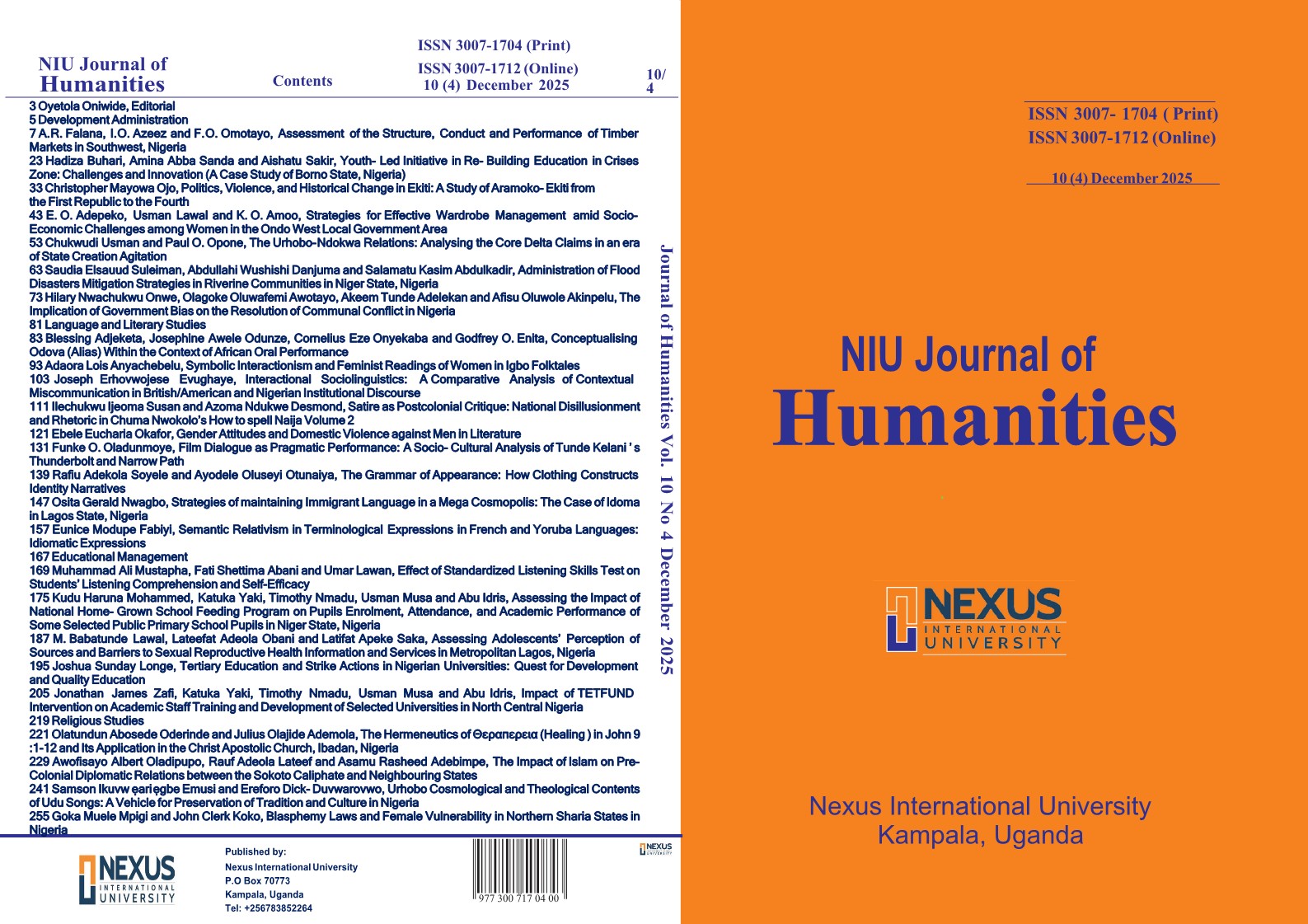 NIU Journal of Humanities, Vol. 10 No. 4, December 2025
Vol 10 No 4 (2025)
NIU Journal of Humanities, Vol. 10 No. 4, December 2025
Vol 10 No 4 (2025)This issue of NIU Journal of Humanities touches on Development Administration, Educational Management, Religious Studies as well as Language and Literary Studies.
The first part of the Journal focuses on Development Administration. One of the papers in this section examines the problem of flooding in several communities in Niger State which is becoming more worrisome and provides efforts and strategies at reducing the impact have become more costly with unsatisfactory outcomes. Findings in the study reveal that that various mitigation strategies have been used over the years but without much impact due to poor awareness and community engagement and responses during flood disasters. These consistent findings underscore the need for comprehensive community awareness, engagement and quick responses during flood disasters. It is further suggested that the communities should be productively engaged in the administration of the various flood mitigation strategies for quick and adequate responses during flood disasters.
The second part is on Language and Literary Studies. One the papers in this Section reveals that there are potential problems encountered by students in their bid to get or guess the correct French equivalent of Yoruba idiomatic expressions because of their background in the French language, their non-familiarity with the idiomatic expressions, poor knowledge of the French idiomatic expressions, the degree of the idiomacity. This paper therefore, recommends that there should be a course on French idioms that will expose learners the more to French culture, and conventional phrases that will improve their vocabularies.
One of the papers, in the third section on Educational Management, argues that the School Feeding Programme (SFP) has had a positive impact on pupil enrolment, attendance and academic performance, as perceived and affirmed by the pupils themselves, teachers, and parents. The study therefore, recommends government should ensure that there is an increase in the number and quality of teachers to accommodate the potential increase in enrolment. Additionally, there should be sufficient physical facilities, such as classrooms and other learning spaces, to avoid overcrowding and provide a conducive environment for effective teaching and learning.
Papers in the last section deals with issues in Religious Studies. One the papers in this Section investigates how Islamic principles, legal frameworks, and scholarly connections influenced foreign relations, alliances, and conflict resolution between Sokoto and other Hausa land such as Zauzau, Kano, Rano, Katsina, Daura and other Hausa States. And the Results indicate that Islam acted not only as a spiritual foundation but also as a diplomatic tool that validated authority, governed warfare through the jihad concept, and enabled peaceful resolutions. This paper therefore, suggests that modern African nations reconsider the ethical aspects of Islamic diplomatic traditions such as justice, accountability, and peaceful conflict resolution to enhance contemporary methods of resolving disputes, fostering regional cooperation, and engaging in interfaith dialogue.
On the whole, this issue of NIU Journal of Humanities features many empirical and theoretical based articles which can be of great benefit to every reader.
-
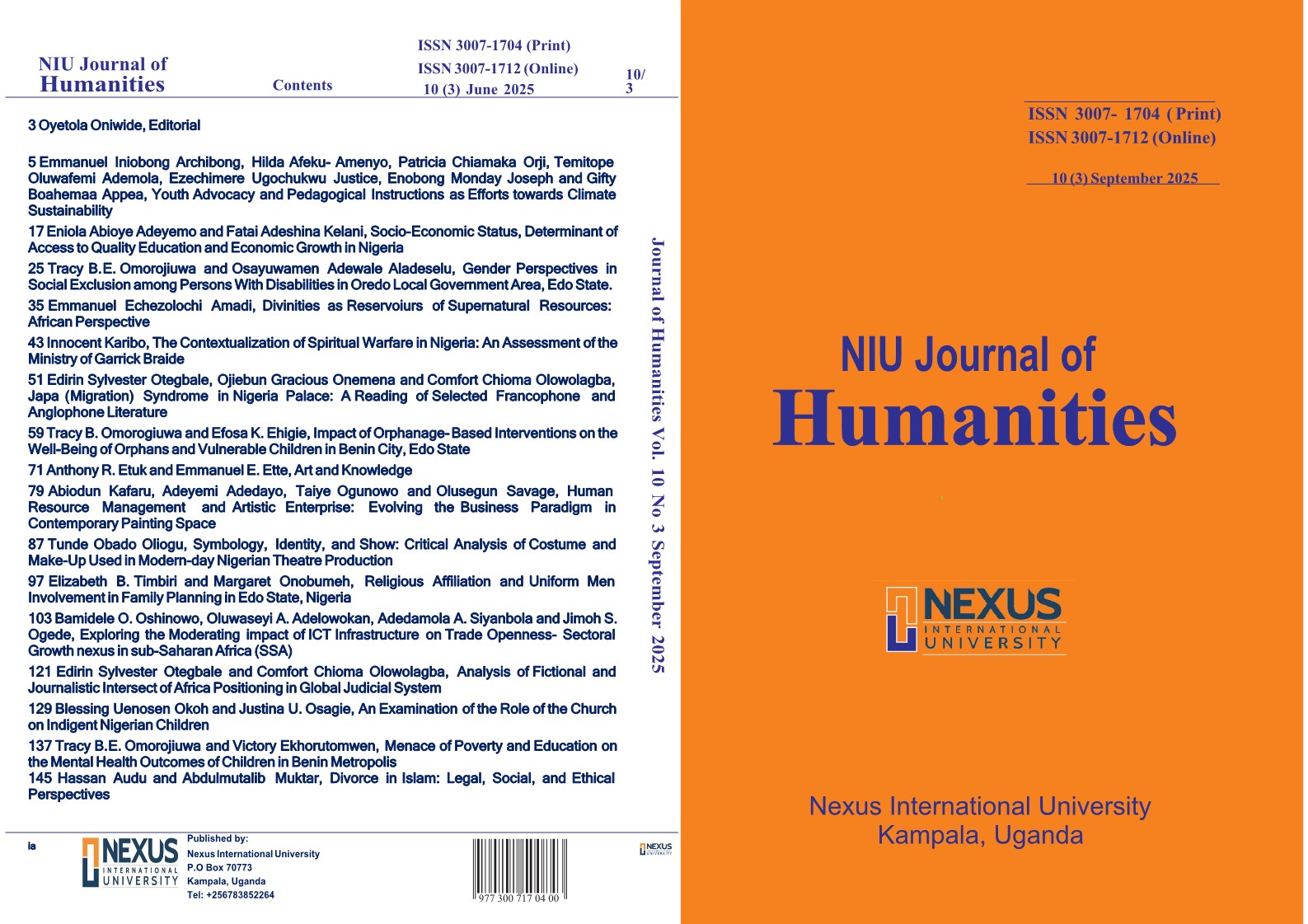 NIU Journal of Humanities, Vol. 10 No. 3, September 2025
Vol 10 No 3 (2025)
NIU Journal of Humanities, Vol. 10 No. 3, September 2025
Vol 10 No 3 (2025)This edition of NIU Journal of Humanities touches on Youth Advocacy and Pedagogical Instructions, Impact of Orphanage-Based Interventions, Human Resource Management and Artistic Enterprise, Symbology, Identity, and Show as well as Business Paradigm in Contemporary Painting Space.
One of the papers, in this issue, reveals that pedagogical instructions enhanced climate sustainability by equipping youth with appropriate knowledge, skills, and platforms to engage in climate action initiatives. Youth advocacy conclusively, is expected to promote policy changes, community engagement, and sustainable practices while mitigating the impact of climate change. It is therefore, suggested that the holistic and inclusive approach to climate education should foster a generation of climate-conscious and empowered youth who can contribute to a more sustainable future for all.
Another paper also reveals that access to educational resources, teacher quality and availability of school facilities and infrastructures determines Quality Education needed for Economic Growth in Nigeria. It recommends that Government should allocate more funds for public education in order to be accessible to all.
This issue of NIU Journal of Humanities features many empirical and theoretical based articles which can be of great benefit to every reader.
-
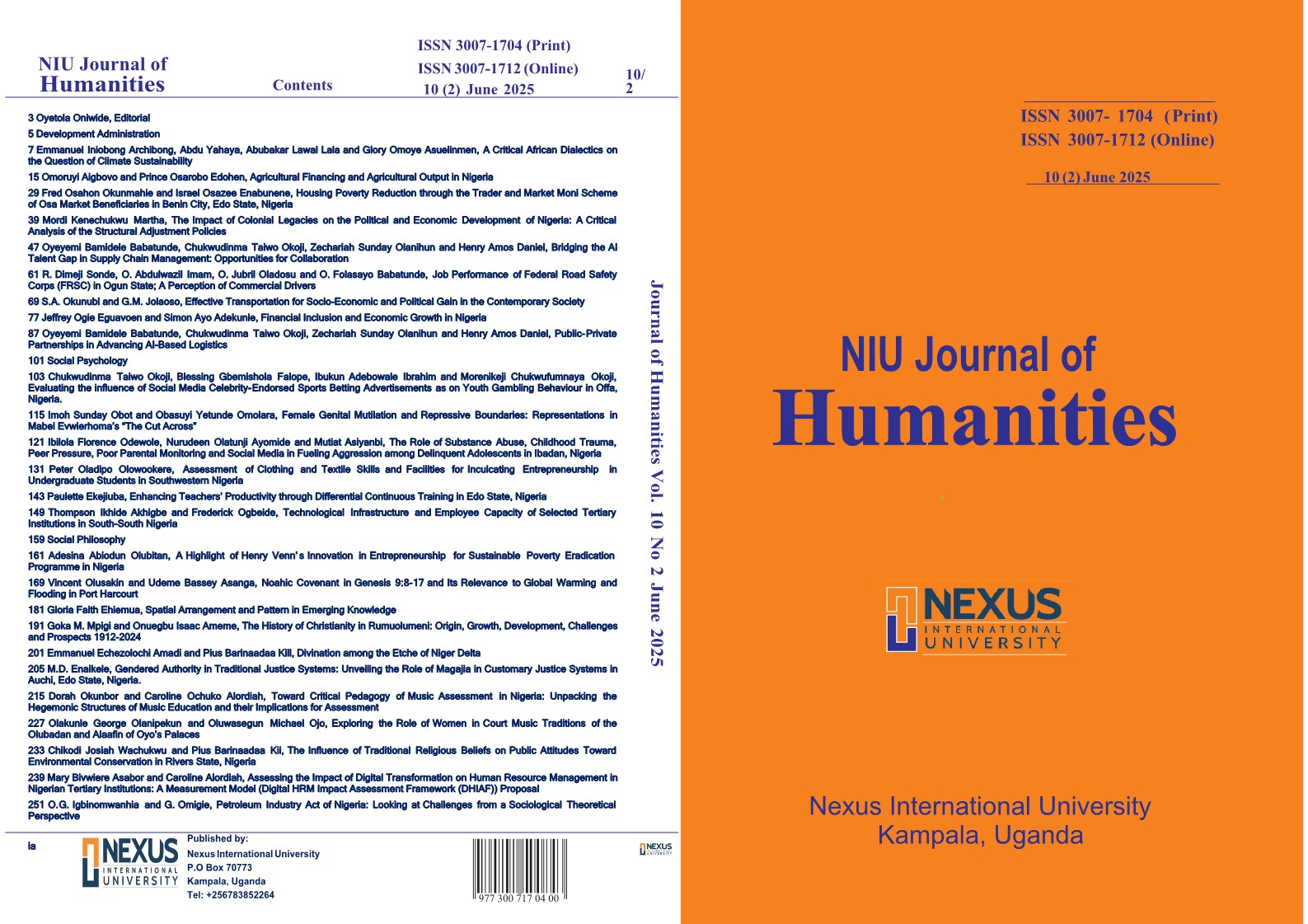 NIU Journal of Humanities, Vol. 10 No. 2, June 2025
Vol 10 No 2 (2025)
NIU Journal of Humanities, Vol. 10 No. 2, June 2025
Vol 10 No 2 (2025)This edition of NIU Journal of Humanities touches on Development Administration, Social Psychology as well as Social Philosphy.
The first part of the Journal focuses on Development Administration. Using Housing Poverty Reduction through the Trader and Market Moni Scheme of Osa Market Beneficiaries in Benin City, Edo State, Nigeria as a case study, one of the papers in this section empirically argues that that the micro-credit loan scheme has contributed largely to reducing the housing poverty of recipients. To mitigate the negative effects of inadequate or non availability of loans, the study recommends that the Trader and Moni loan scheme be overhauled for better functioning, and increased the loan amount to match the reality in the economy of today among others.
Papers in the second section are on Social Psychology. Using Youth Gambling Behaviour in Offa, Nigeria as case studies, one of the papers in these sections argues theoretically and demonstrates empirically that celebrity-endorsed sports betting advertisements moderately influence gambling engagement. It highlights the ethical concerns surrounding the normalisation of gambling through celebrity endorsements and the need for responsible advertising strategies. It recommends therefore, stronger regulatory oversight, clearer risk disclaimers, and further research on the long-term effects of repeated exposure to such advertisements, particularly among vulnerable audiences.
One of the papers, in the last section on Social Philosophy, examines the roles of of women in Court Music Traditions of the Olubadan and Alaafin of Oyo’s Palaces. The study is anchored on how women's participation in court music serves as a platform for gender expression, social mobility, and cultural resilience.
This issue of NIU Journal of Humanities features many empirical and theoretical based articles which can be of great benefit to every reader.
-
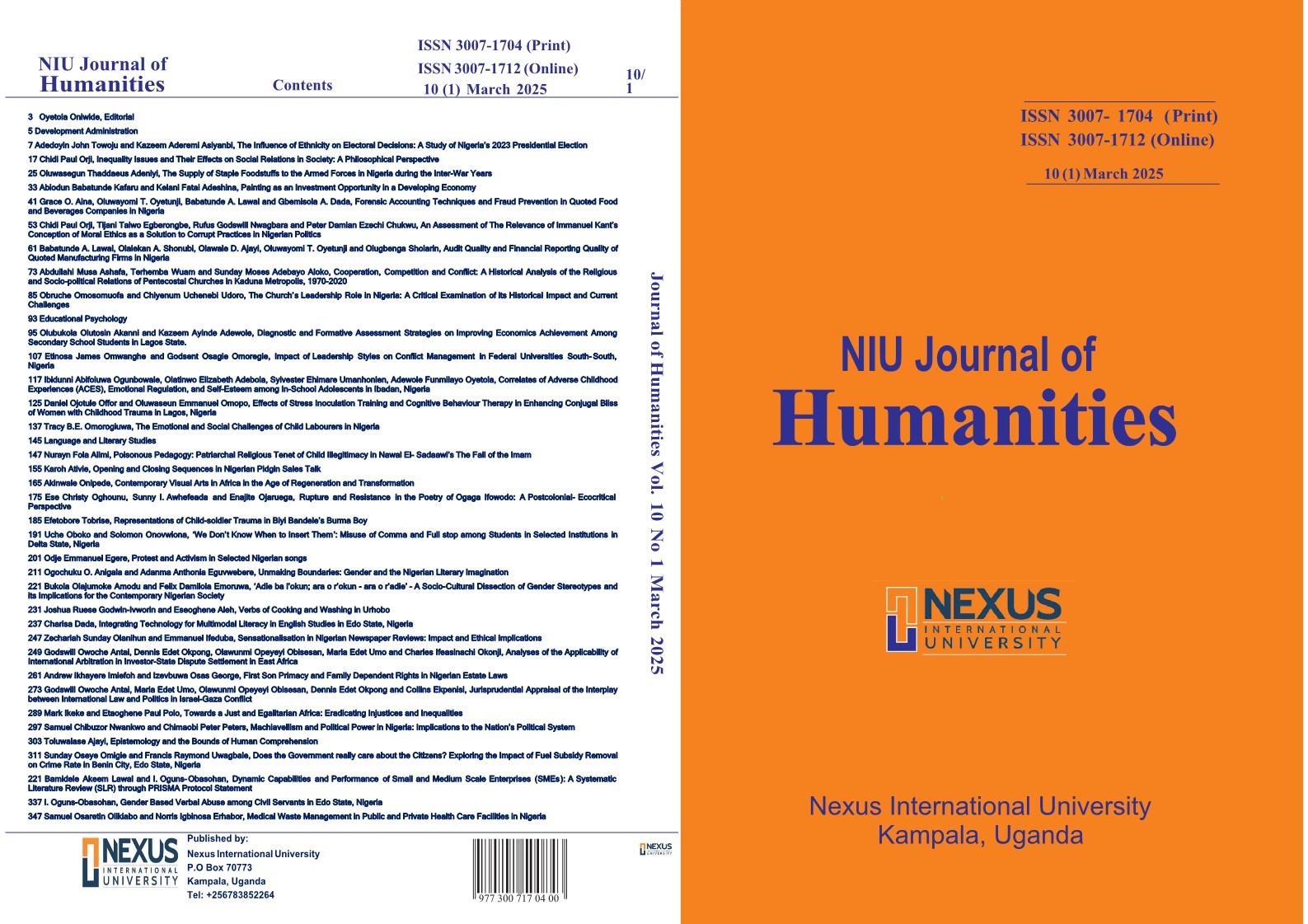 NIU Journal of Humanities, Vol. 10 No. 1, March 2025
Vol 10 No 1 (2025)
NIU Journal of Humanities, Vol. 10 No. 1, March 2025
Vol 10 No 1 (2025)This edition of NIU Journal of Humanities touches on Development Administration, Educational Psychology as well as Language and Literary Studies.
The first part of the Journal focuses on Development Administration. Using Nigeria’s 2023 Presidential Election as a case study, one of the papers in this section empirically argues that ethnicity significantly influenced voter decisions and highlights the challenges posed by ethnic-driven voting patterns. To mitigate the negative effects of ethnic polarization in elections, the study recommends targeted civic education initiatives led by the Nigerian government, the National Orientation Agency (NOA), and educational institutions. Implementing a civic education curriculum that fosters national unity and encourages policy-driven electoral choices will be critical to strengthening democratic process.
Papers in the second section are on Educational Psychology. Using Secondary School Students in Lagos State, Nigeria as case studies, one of the papers in these sections argues theoretically and demonstrates empirically that there is a significant relationship between formative evaluation feedback and students' academic achievement in Economics. It is therefore recommended that school teachers should acquire updated skills and best practices in using diagnostic evaluation to enhance students' academic performance, not only in Economics but across all subjects.
One of the papers, in the last section on Language and Literary Studies, examines the roles of musical artistes who use their songs as a tool for protest and activism against the government. The study is anchored on the theory of relative derivation, which is defined as the perceived lack of resources required to maintain quality life in a society.
-
 NIU Journal of Humanities, Vol. 9 No. 4, December 2024
Vol 9 No 4 (2024)
NIU Journal of Humanities, Vol. 9 No. 4, December 2024
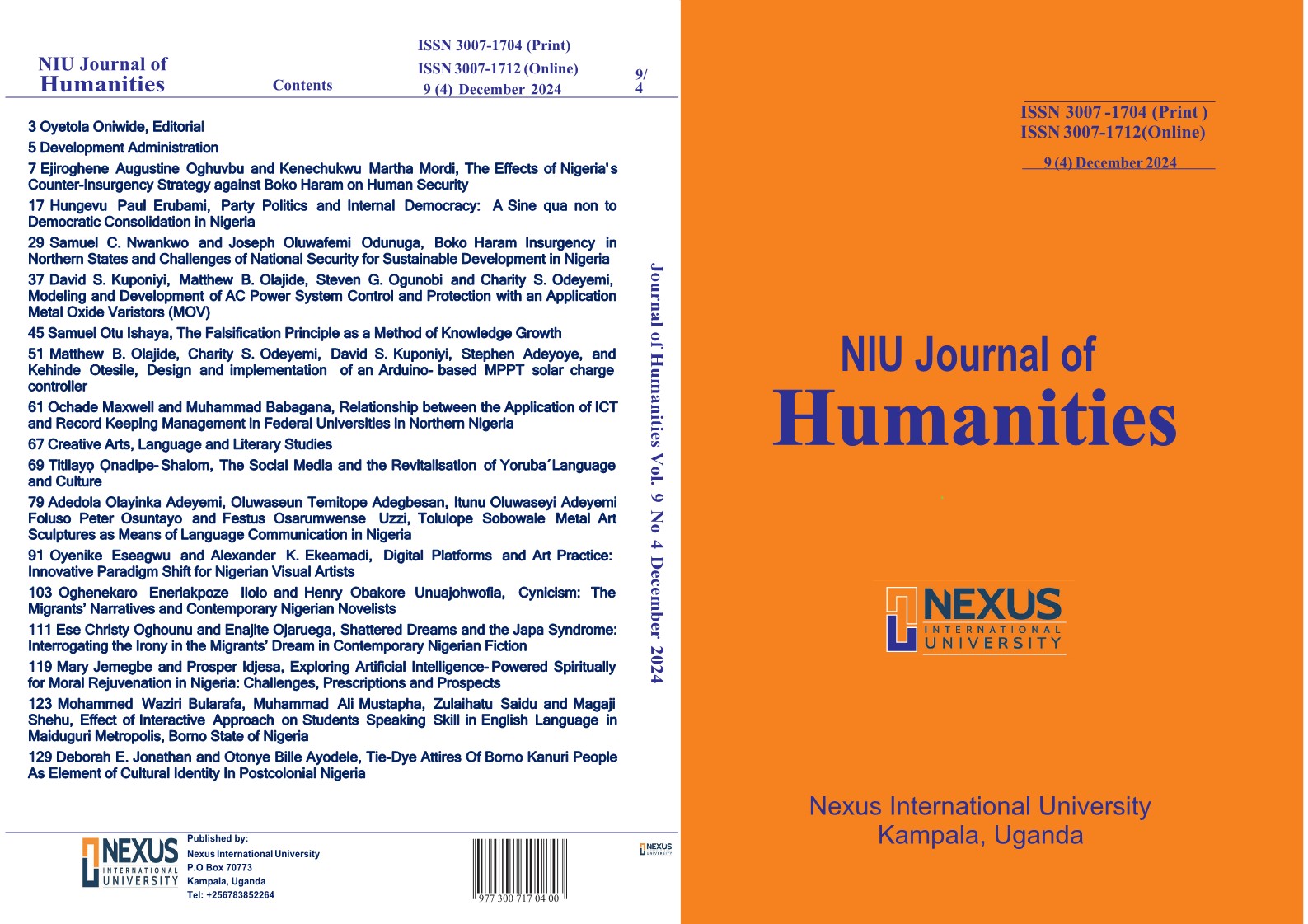
Vol 9 No 4 (2024)This issue of NIU Journal of Humanities touches on Development Administration as well as Language and Literary Studies.
The first part of the Journal focuses on Development Administration. Using Nigeria's Counter-Insurgency Strategy against Boko Haram as a case study, one of the papers in this section empirically argues that although Nigeria's counter-insurgency tactics against Boko Haram are effective from the start, they do not crush and eradicate the movement; rather, they encourage a resurgence of the movement with increasingly complex waves of armed violence against the government and its security forces, as well as egregious violations of human rights and implications for the safety of the civilian population. It is revealed that a long-term solution to these security issues is unlikely as long as these counter-insurgency tactics are the sole means of combating the Boko Haram insurgency. It is, therefore, recommended that the government should create policies and strategies to lessen and eliminate social problems by limiting the activities of Boko Haram members in the northeast, through border control.
One of the papers, in the second section on Language and Literary Studies, investigates the outcome of the migrants’ dream whether in the diaspora or their return to their home country. The result is failure of the migrants’ dream. The themes of loss of job, depression, divorce, dropout and death become the outcome of the dream of social or economic upliftment by the migrant. The techniques of flashback, contrast and symbolism enable the migrant storytellers to achieve a realistic point of view. It also discovered in this paper that the major reason for the failure of the migrants’ dream is the process of acculturation and hybridity - the unsuccessful merger of the migrants’ home culture and that of the diaspora. The paper concludes that the migrant literature is a realistic portrayal of the “Japa” syndrome. The outcome of the syndrome is always negative in the novel.
This edition of NIU Journal of Humanities features many empirical and theoretical based articles which can be of great benefit to every reader.
-
 NIU Journal of Humanities, Vol. 9 No. 3, September 2024
Vol 9 No 3 (2024)
NIU Journal of Humanities, Vol. 9 No. 3, September 2024
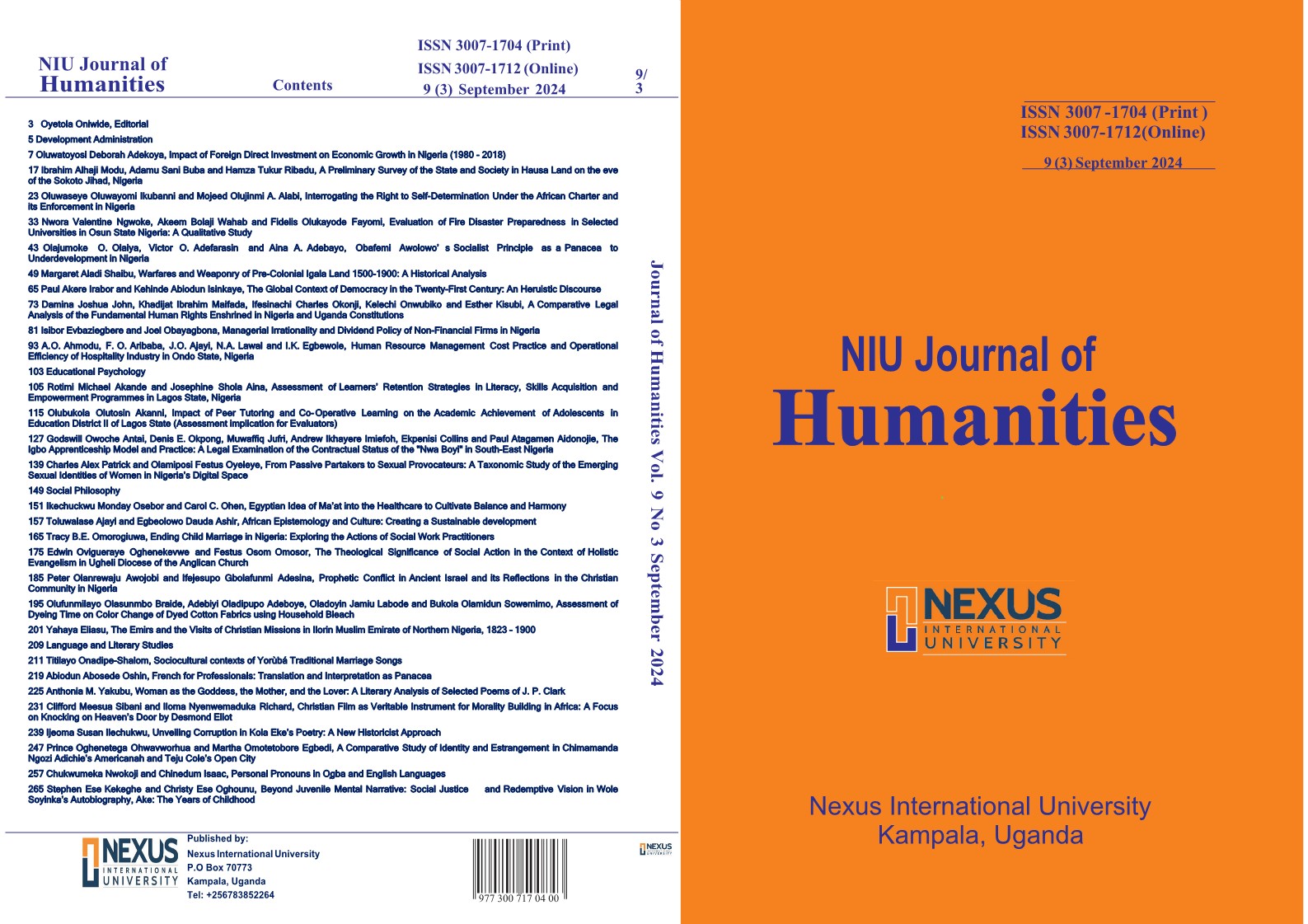
Vol 9 No 3 (2024)This edition of NIU Journal of Humanities touches on Development Administration, Educational Psychology, Social Philosophy as well as Language and Literary Studies.
The first part of the Journal focuses on Development Administration. Analysing the impact of Foreign Direct Investment in Nigeria from 1980 to 2018, one of the papers in this section indicates that FDI is a significant measure of growth and that the determinants of foreign direct investment include infrastructural facilities, openness to trade, and exchange rate which are positively related and statistically significant to economic growth. The paper therefore, recommends that the government improve infrastructural facilities such as stable electricity supply, good roads, and a conducive environment to assure foreign expatriates about their safety and investment. This will boost investment inflow into society and reduce local investors’ emigration.
One of the papers, in the second section on Educational Psychology, proves that cooperative learning, peer tutoring exerts a significant influence on students’ achievement in Mathematics lastly, the joint effect of students’ use of cooperative learning and peer tutoring towards Mathematics was significant on their academic achievement, when such effect accounted for 27.6% of the variance in the students’ academic achievement; such significant effect emanated from the individual significant contribution or influence which the culture of using peer tutoring had on academic achievement, while the culture of using cooperative learning had no significant effect on academic achievement.. It is therefore, recommended among others that the Nigerian Government, Ministry of Education and all well-meaning education stakeholders should encourage the school teachers with financial aids or incentives in order to attend seminars and capacity building workshop in relation to best practices of using cooperative learning and peer tutoring to impart knowledge in mathematics, and that curriculum planners should replicate this research in order to authenticate the findings obtained.
In the third section on Social Philosophy, one of the papers reveals the influence of western culture has caused certain customs and beliefs to be discarded or modified, at the same time, it has caused others to be retained by one level of society while on another level new alternatives are being accepted and concludes that knowledge is crucial to human survival and flourishing, African culture is embedded in strong epistemic considerations. African epistemology is an important component of culture.
Papers in the last section deals with issues in Language and Literary Studies. Several literary works are examined in order to provide a useful contribution to how different worldview unites and differs in the human search to unravel 'truth'. Using Dell Hyme's Ethnography of Communication which explores the use of various means of communication among particular people, one of the papers in this section, examines the sociocultural elements of Yoruba traditional wedding songs and performance which has been neglected in earlier works.
On the whole, this edition of NIU Journal of Humanities features many empirical and theoretical based articles which can be of great benefit to every reader.
-
 NIU Journal of Humanities, Vol. 9 No. 2, June 2024
Vol 9 No 2 (2024)
NIU Journal of Humanities, Vol. 9 No. 2, June 2024
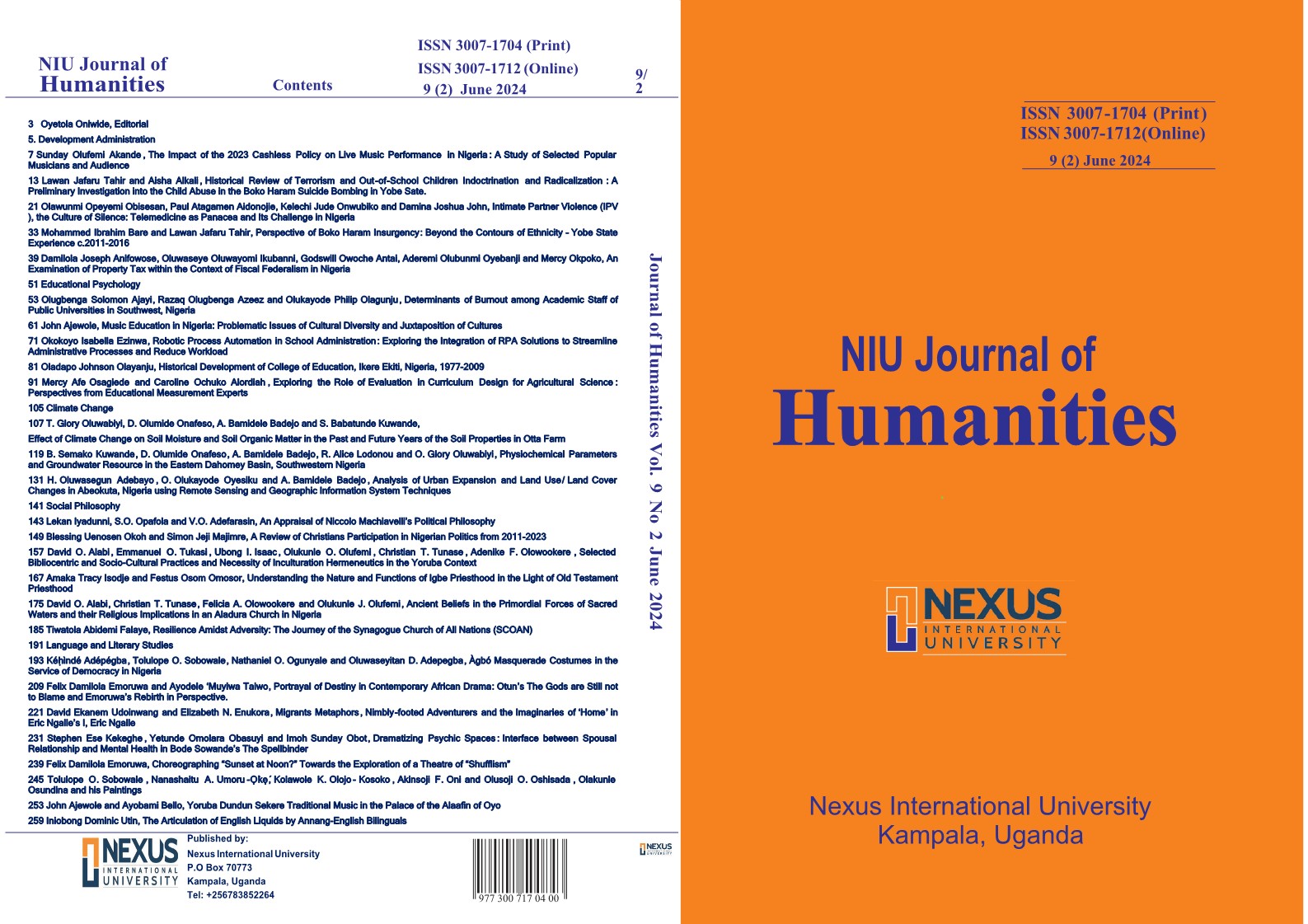
Vol 9 No 2 (2024)This issue of NIU Journal of Humanities touches on Development Administration, Educational Psychology, Climate Change, Social Philosophy as well as Language and Literary Studies.
The first part of the Journal focuses on Development Administration. Using the Fiscal Federalism of Nigeria as a case study, one of the papers in this section empirically identifies the major challenges proterty tax and fiscal federalism to include: centralization at the state level, the absence of a comprehensive database, tax evasion, legal exemptions, skill shortages, lack of political will, and corruption. The paper recommends, amongst others, that the state government should states to relinquish the unconstitutional centralization of property tax functions and empowering local governments for independent assessment and collection.
One of the papers, in the second section on Educational Psychology, argues that moral education as a means of regenerating social norms and moral values. It is revealed in the paper, among other things, that job decision latitude was the main contributor to the prediction of burnout of academic staff of public universities and that university academic staff members are not immune to burnout and other-work related challenges affecting workers generally. It is therefore, recommended that Government, university administrator and university management should improve on university work environment by providing necessary facilities that will enhance favourable work environment. This in turn will reduce the level of burnout among the university academic staff.
In the third section on Climate Change, one of the papers reveals that temperature and precipitation affected soil moisture and organic matter from 1996-2016 and recommends the application of organic materials on soil to increase organic matter content and the practise of mulching will also conserve soil moisture.
One of the papers, in the fourth section on Social Philosophy, examines those cultural practices in the bible that are similar to African cuture. These biblical practices are juxtaposed with similar African cultural practices in order to better illustrate the teaching of the Bible to the Africans with the tool of “inculturation hermeneutics” for the exegetes.
Papers in the last section deals with issues in Language and Literary Studies. Several lierary works are examine in order to provide a useful contribution to how different worldview unites and differs in the human search to unravel 'truth'.
-
 NIU Journal of Humanities, Vol. 9 No. 1, March 2024
Vol 9 No 1 (2024)
NIU Journal of Humanities, Vol. 9 No. 1, March 2024
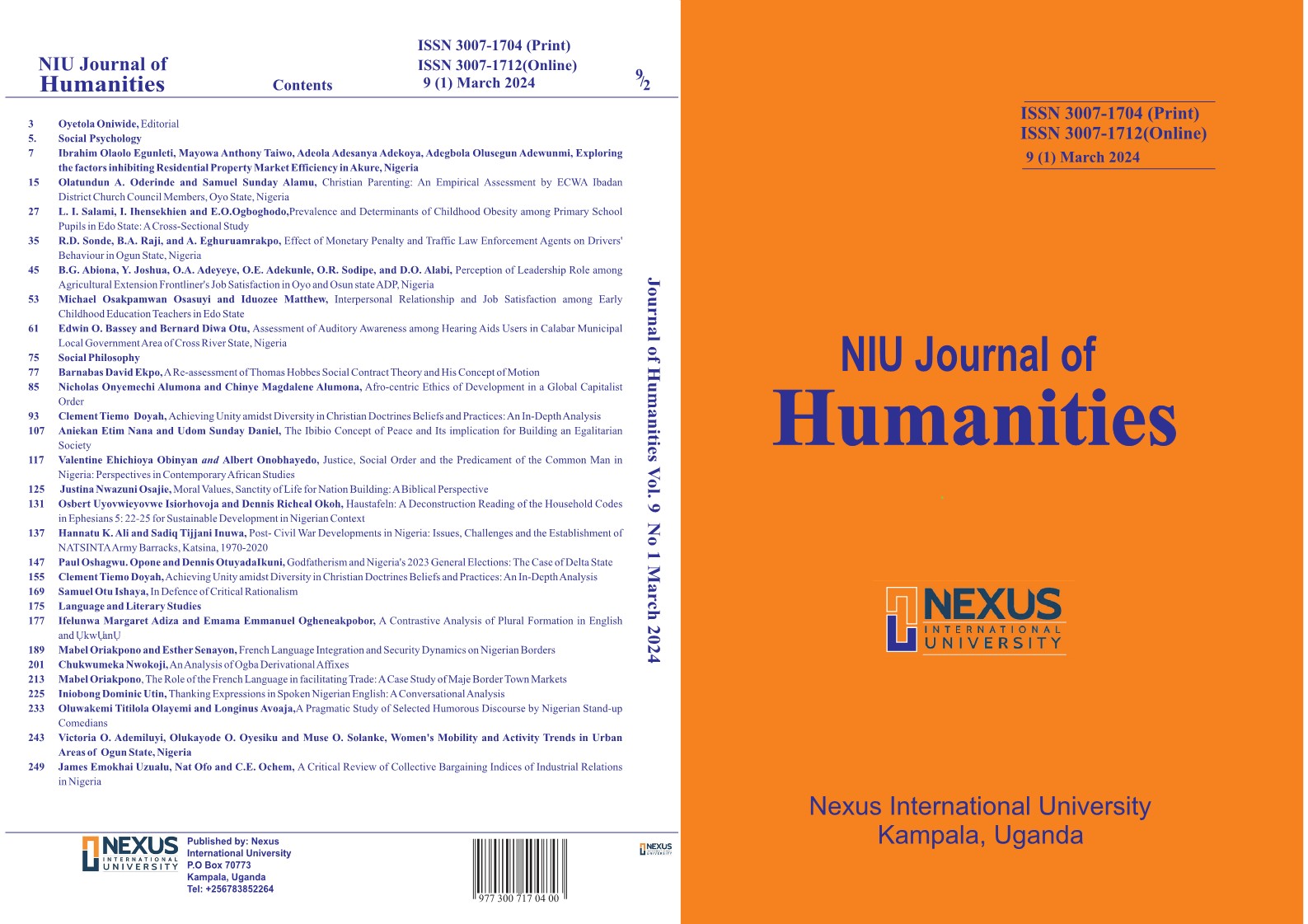
Vol 9 No 1 (2024)This issue of NIU Journal of Humanities touches on Social Psychology, Social Philosophy, as well as Language and Literary Studies.
The first part of the Journal focuses on Social Psychology. Using ECWA Ibadan District Church Council Members, Oyo State, Nigeria as a case study, one of the papers in this section empirically extols the values of christian parenting style. It is argued that non-compliance with the parenting principles by many parents has resulted into children’s lack of commitment to society’s values. Some social vices were identified as problems resulting from this non-compliance. The paper recommends, amongst others, that church members should develop informed teaching on parenting to serve as basis for instructing Christians generally, seminars and workshops should be organized for parents on the need to bring this to bear on their children, and parents must not commit the entire responsibility of parenting into the hands of the church, the school or any house help.
One of the papers, in the second section on Social Philosophy, argues that moral education as a means of regenerating social norms and moral values. It is revealed in the paper, among other things, that moral values which are seen as behavioural conduct and attitude, should be displayed and encouraged by members of the society to build and revitalized the nation. It is there recommended moral education should be taught in schools, with the collaboration of parents and government.
Papers in the last section deals with issues in Language and Literary Studies. One the papers in this Section examines the role of French Language in facilitating trade in boader town markets in West African countries. This is because there is an intriguing complex relationship between language, trade, and cross-border connections. The paper, therefore, offers insightful information to policymakers, market participants, and language planners who aim to encourage inclusive economic development and cross-cultural understanding.
On the whole, this issue of NIU Journal of Humanities features many empirical and theoretical based articles which can be of great benefit to every reader.
-
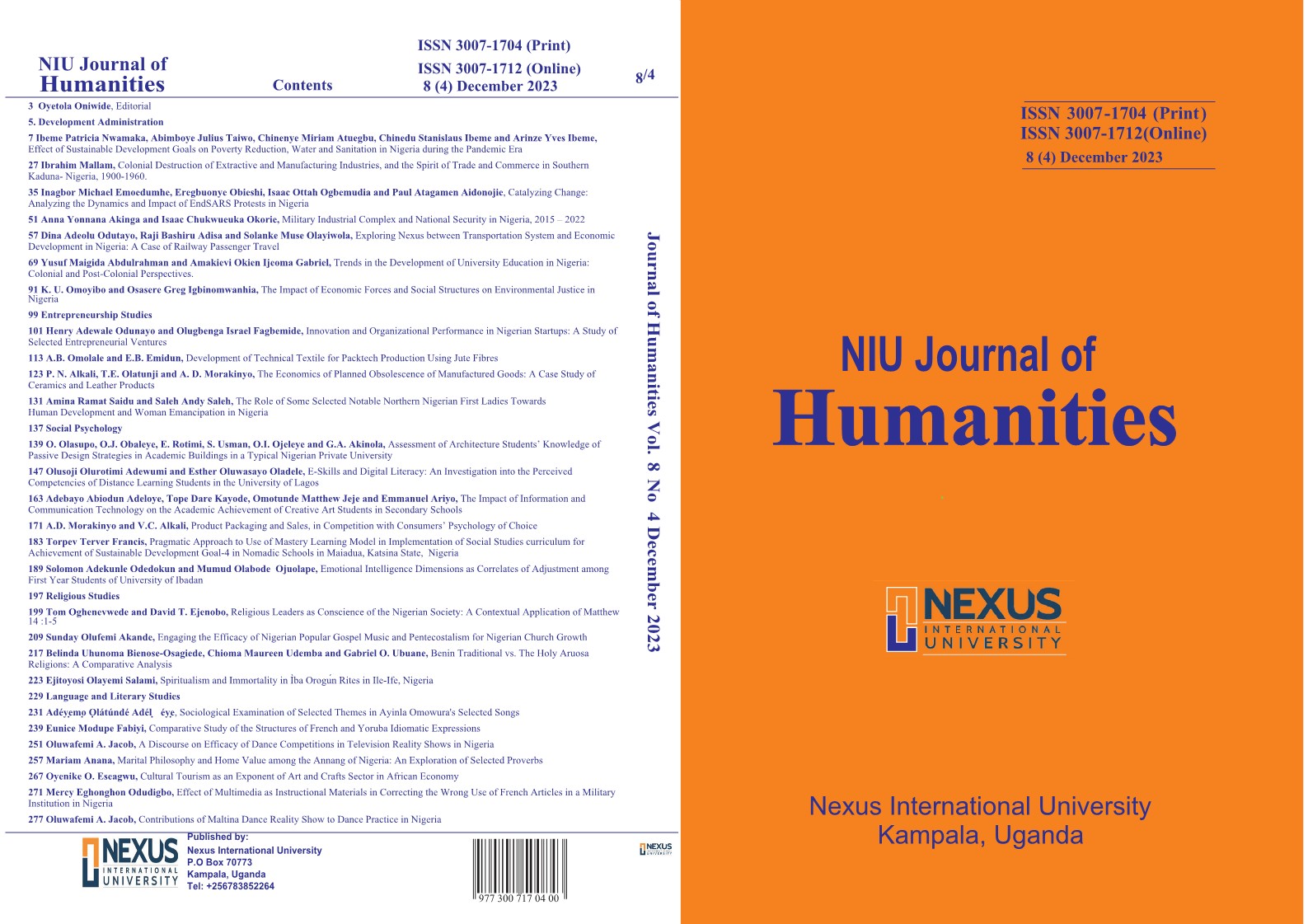 NIU Journal of Humanities, Vol. 8 No. 4, December 2023
Vol 8 No 4 (2023)
NIU Journal of Humanities, Vol. 8 No. 4, December 2023
Vol 8 No 4 (2023)This issue of NIU Journal of Humanities touches on Development Administration, Enterprenurship Studies, Social Psychology, Religious Studies as well as Language and Literary.
The first part of the Journal focuses on Development Administration. One of the papers in this section explores the relationship between economic performance and transport investments. It is argued that the level of economic performance determines the usage of transport in Africa and Nigeria in particular. Findings in the study align with existing research in the field of transportation economics, emphasizing the persistent role of historical passenger travel patterns and the nuanced impact of economic factors, such as GDP and inflation, on railway passenger travel. These consistent findings underscore the need for comprehensive, long-term planning and investment strategies in the rail transportation sector, taking into account a range of factors beyond just economic conditions.
One of the papers, in the second section on Enterprenuship Studies, argues that Government policies and a supportive ecosystem have a positive impact on innovation and performance while Sectoral variations necessitate tailored strategies. The study therefore, recommends strategic resource allocation, adoption of context-specific metrics, collaboration with government initiatives, and sector-specific focus to enhance startup success. These recommendations, according to the research work, are instrumental for startups, policymakers, and stakeholders in the Nigerian entrepreneurial ecosystem.
Papers in section three explore issues in Social Psychology. Examining whether appearance of consumer products creates a particular impression that compels a consumer to make his choice of a product leading to sales, one of the papers in this section postulates that in spite of new technologies and materials, consumer's choices and desires constitute the most important elements that drive the marketing process. Therefore, the ceramic designer must put the customer in the fore front not himself when it comes to product appearance. The designer must also look into brand personality, the five (5) brand personality dimensions, deliberate feedback etc. as added issues to the six roles of product packaging to compel the psychology of consumers’’ choice and sales. Thus, the postmodernist philosophy of self-projection in our productive endeavours at the expense of consumer choice must be discouraged at this stage of development of ceramic if wares will compel their commercial values and retain customers’ loyalty beyond the five life cycle of a product.
Using the encounter between King Herod and John the Baptist as narrated in Matthew 14:1-5, one of the reseach works, in Section Four which centers on Religiuos Studies, interrogates the texts to identify how religious leaders can play the function of the conscience of the society in ensuring that morality prevails in the society. Using the textual critical method of study, the hermeneutics contained in the text were identified and contextualized to the current Nigerian environment. The work identified seven distinct areas in which religious leaders in Nigeria can make their impact felt in becoming the conscience of the society. It is the contention of this work that religious leaders are most appropriately poised to lead the crusade against moral degradation in the Nigerian society.
Papers in the last section deals with issues in Language and Literary Studies. One the papers in this Section examines Idioms in both Youruba and French Languages. This is because Yoruba and French languages are so rich in the use of idiomatic expressions which lend themselves easily in the hands of those who know the two languages, through limitless improvisation of idiomatic expressions. In friendly, family and societal conversations, idiomatic expressions occupy a unique place. Their importance cannot be over emphasized as they add beauty to the speeches that employ them and provide knowledge and wisdom for better and clear understanding of the messages being projected. This paper therefore, examines idiomatic expressions in both languages at different fora.
On the whole, this issue of NIU Journal of Humanities features many empirical and theoretical based articles which can be of great benefit to every reader.
-
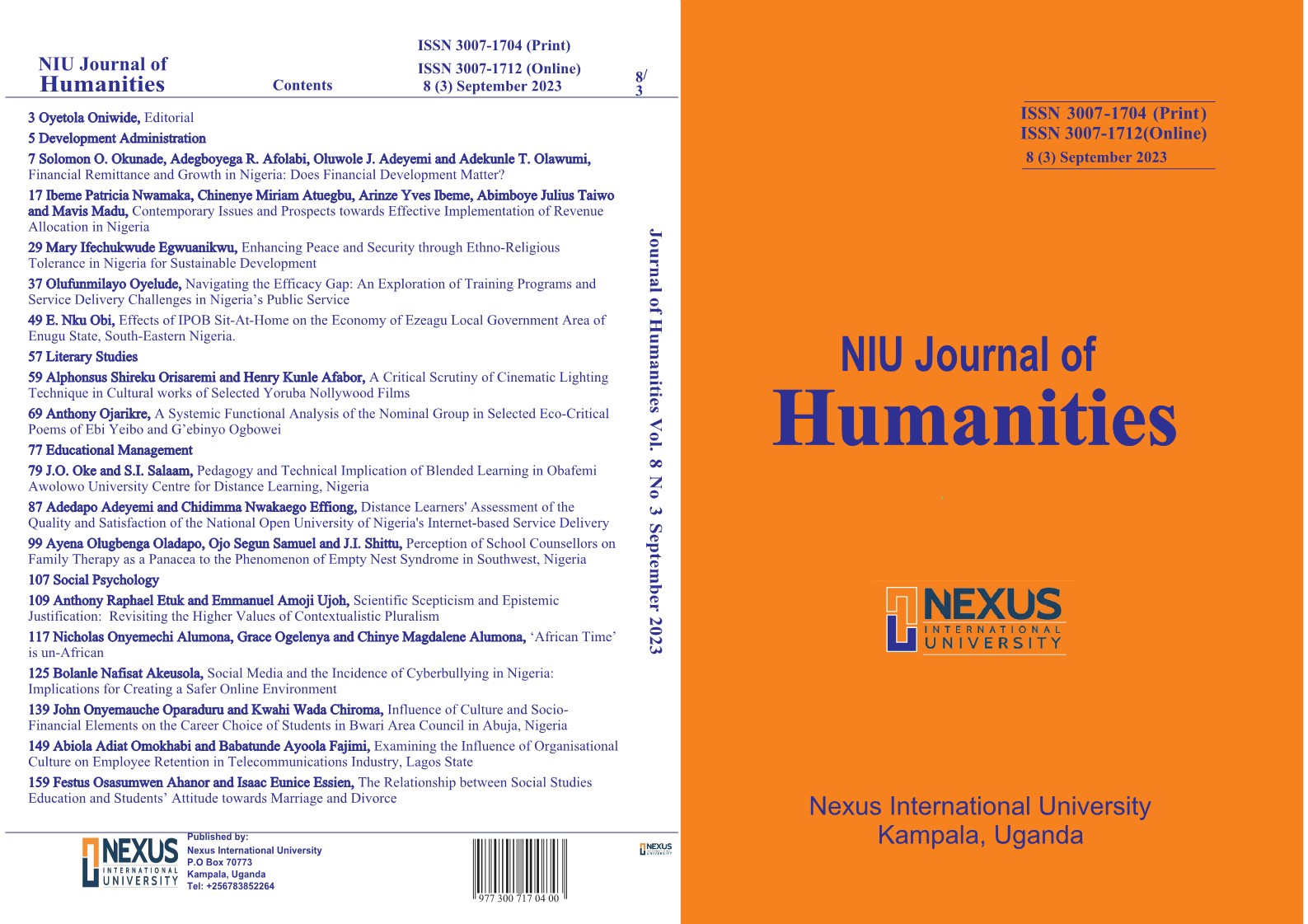 NIU Journal of Humanities, Vol. 8 No. 3, September 2023
Vol 8 No 3 (2023)
NIU Journal of Humanities, Vol. 8 No. 3, September 2023
Vol 8 No 3 (2023)This issue of NIU Journal of Humanities touches on Development Administration, Literary Studies, Educational Management and Social Psychology.
The first part of the Journal focues on Development Administration. One of the papers in this section reveals the contemporary issue of revenue allocation and identified challenges which embedded as outlining prospects for it. It is uncovered that in a bid strategy to resolve the controversial issues surrounding the contentious revenue allocation in Nigeria, a high level of fiscal decentralization is required in replacing the unfair revenue sharing formula currently on operations. This paper, therefore, recommends that revenue formulae for revenue sharing should be guided by national interest, which should take precedence over individual or primordial attention and reactions.
One of the papers, in the second section on Literary Studies, is a reaction to the brazen exploitation of petroleum resources in the Niger Delta without compensation and environmental impact assessment by the Nigerian government and the international oil companies. Three representative poems are selected from different collections of the two poets. They are analysed using Systemic Functional Grammar as theoretical framework. The systemic functional analysis of the Nominal Group brings out the eco-critical features of the poems.
Papers in section three explore issues in Educational Management. Examining the perception of school counselors on family therapy as a panacea to the phenomenon of empty nest syndrome in Southwest Nigeria, it is postulated in one of the papers that school counselors are experts in using different approaches and therapies in handling various challenges that humans are facing in their daily livelihood. Hence, their inability to unanimously agree in their choice of family therapy as an antidote to empty nest syndrome. It is, however, recommended that the use of family therapy and other approaches and therapies may be appropriate in handling empty-nest syndrome.
Papers in the last section deals with issues in Social Psychology. While advocating that culture and parents' socioeconomic status strongly influence students' career choices, one of the papers in this section, recommends that school leaders should teach students about social factors that may influence their career choice. Also, parents are admonished to stop pushing their kids into careers they don't fit into but they should rather work with school advising or professional guides to help their children choose smart careers. Moreso, guardians should be cautious about pushing their children toward unrealistic careers.
On the whole, this issue of NIU Journal of Humanities features many empirical and theoretical based articles which can be of great benefit to every reader.
-
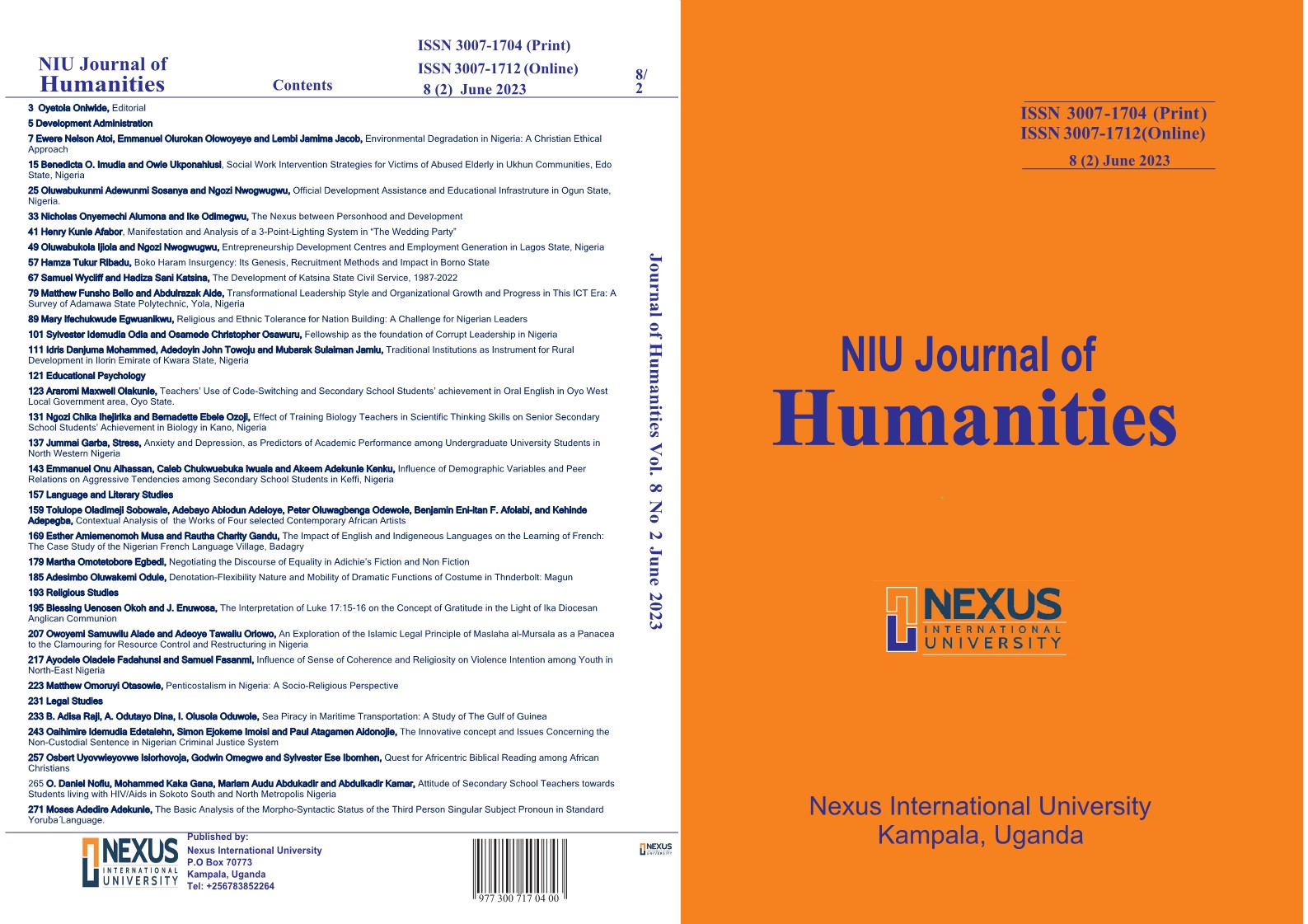 NIU Journal of Humanities, Vol. 8 No. 2, June 2023
Vol 8 No 2 (2023)
NIU Journal of Humanities, Vol. 8 No. 2, June 2023
Vol 8 No 2 (2023)This issue of NIU Journal of Humanities touches on Development Administration, Educational Psychology, Literary Studies, Religious Studies and Legal Studies.
The first part of the Journal focues on Development Administration. One of the papers in this section reveals that that there are both natural and human causes of environmental degradation eventhough human causes are more than the natural. It is uncovered that humans have continued to exploit nature through the irresponsible use of natural resources. This paper, therefore, concludes that environmental degradation problems in Nigeria can be effectively address through Christian stewardship, eco-justice and creation spirituality, which are the emerging environmental ethical ideologies in contemporary Christianity and other Christian ecological values inherent in the bible. Nigerian Christians must become ambassadors of these environmental ethical principles for effective ecological healing in the country.
Papers in section two explore issues in Educational Psychology. It is postulated in one of the papers that there is a negative or inverse relationship between academic performance and stress, anxiety and depression, meaning that the higher the students’ level of stress, anxiety, and depression, the lower the academic performance. It is, therefore, recommended that school counsellors and psychologists should be encouraged to address the issues of stress, anxiety and depression especially among hundred level students so as to enhance their adjustment and academic performance.
One of the papers, in the third section is on Language and Literary Studies, demonstrates that the spoken aspect of a language is very vital in the learning of a foreign language. The paper lays emphases on effective oral communication amongst students in a bilingual environment and in the same vein recommends some pedagogical techniques in enhancing and promoting effective oral communication in French.
Papers in section four deals with issues in Religious Studies. While advocating socio-economic and religious restructuring of Nigeria based on the principle of maslaha al-mursalaha, one of the papers in this section, recommends that 1999 Constitution should be amended to accommodate laws that will address issues on resource control and restructuring. The paper further recommends that states should be allowed to take 80% of the resources found in their respective states or regions while 20% of the resources should be allocated to the Federal Government. And the Federal Government of Nigeria should also promote justice, fairness and equity (which Islam preaches) among the federating units and continue to wage ‘war’ against corruption, insurgency, militancy, kidnapping and other crimes (which Islam forbids) that are threatening the cooperate existence of Nigeria.
In the last section which centres on Legal Studies, one of the papers concludes and recommends that embracing non-custodial sentencing will reduce prison reception and minimize the enormous government resources in maintaining the prison infrastructure and the prisoners in Nigeria. In this regard, the paper suggests that there is need for a redress of the challenges mitigating the smooth application of non-custodian sentences in Nigeria's criminal Justice System.
On the whole, this issue of NIU Journal of Humanities features many empirical and theoretical based articles which can be of great benefit to every reader.
-
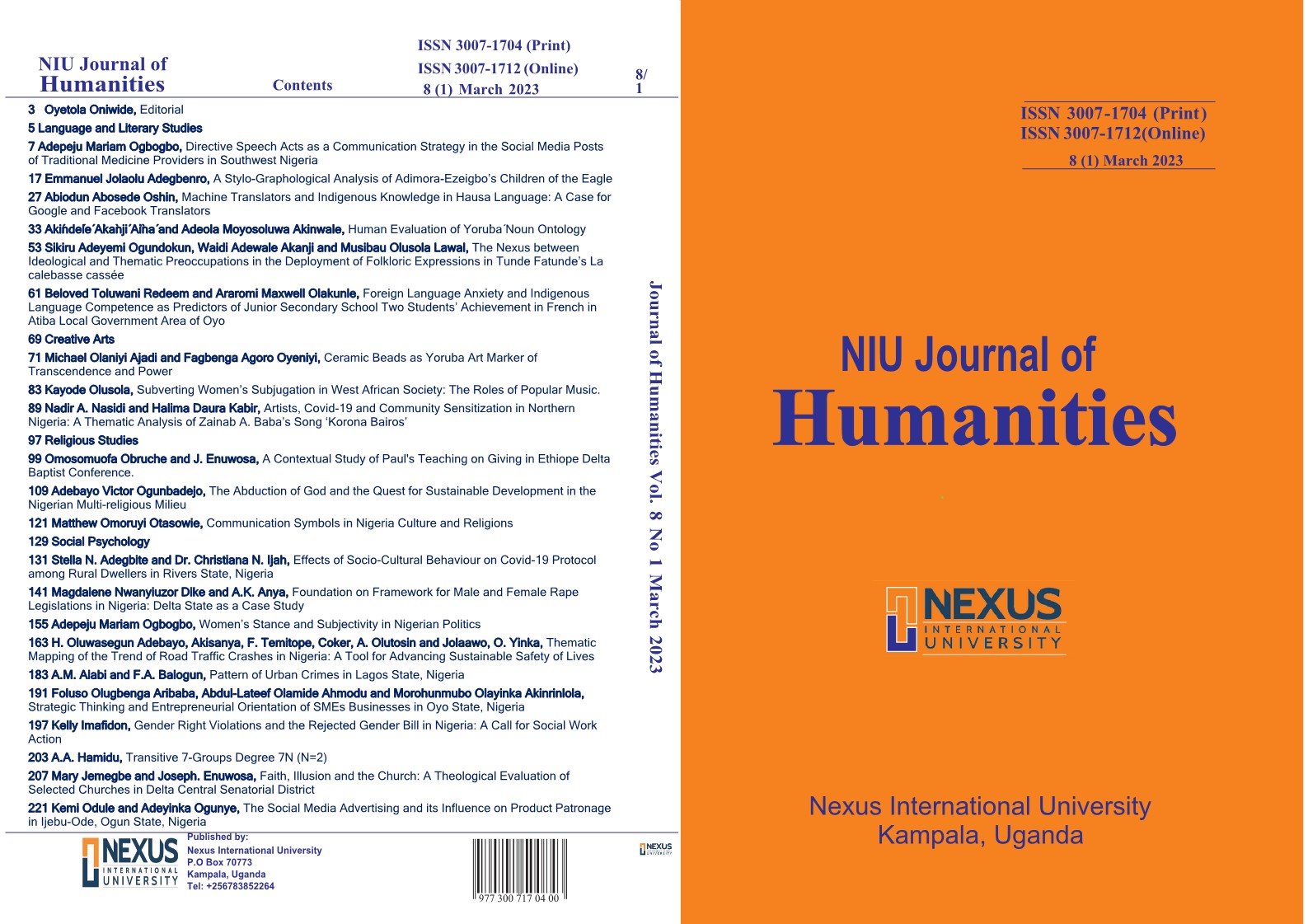 NIU Journal of Humanities, Vol. 8 No. 1, March 2023
Vol 8 No 1 (2023)
NIU Journal of Humanities, Vol. 8 No. 1, March 2023
Vol 8 No 1 (2023)This issue of NIU Journal of Humanities touches on Literary Studies, Creative Arts, Religious Studies and Social Philosophy.
The first part of the Journal focues on Language and Literary Studies. One of the papers in this section reveals that Traditional and Alternative Medicine (TAM) providers employ various pragmatic strategies to project themselves and their services to their audience on Facebook. Specifically, this study identifies that legitimisation, cultural contextuality and identity construction are strategies engaged by these TAM providers to project knowledge, give credence, and dissuade scepticism surrounding traditional and alternative medicine in Nigeria.
Papers in section two explore issues in Creative Arts. It is postulated in one of the papers that apart from the fact that music is an ubiquitous phenomenon which covers every aspect of lives of the African people, popular music, being an integral part of popular culture of a society, has been used as an impactful medium through which women’s subjugation in different West African societies have been subverted to an extent. This is because of its high rate of patronage and ability to reach larger number of audience through the mass media. The paper therefore recommends that government through the Federal Ministry for Women’s Affairs and other corporate organizations for women’s liberation should partner with popular musicians in creating awareness and promoting the campaign against women’s subrogation the West African society.
One of the papers, in the third section is on Religious Studies, demonstrates that Paul’s purposes in writing to the Philippians was to console and commend them and these consolation and commendation purposes are crucial to a proper understanding of the meaning and structure of the letter in relations to giving. It shows that tithing is a legalistic, Old Testament standard, it should be retained as the biblical foundational and traditional basis for giving. The study shows that outside its spiritual rewards, giving generously enhances human mental health and longevity through the reduction of blood pressure and stress.
In the last section which centres on Social Psychology, one of the papers reveals that there were innovative socio-cultural behaviours such as the drinking of herbal drinks to boost immunity, and the use of local made face mask from local fabrics. The study concludes that some socio-cultural behaviours of the people in rural communities tends to prevent the spread of Covid-19 and that such ingenious innovative actions of the rural communities in times of pandemic should be encouraged and integrated into the national health system
In all, this issue of NIU Journal of Humanities features many empirical and theoretical based articles which can be of great benefit to every reader.
-
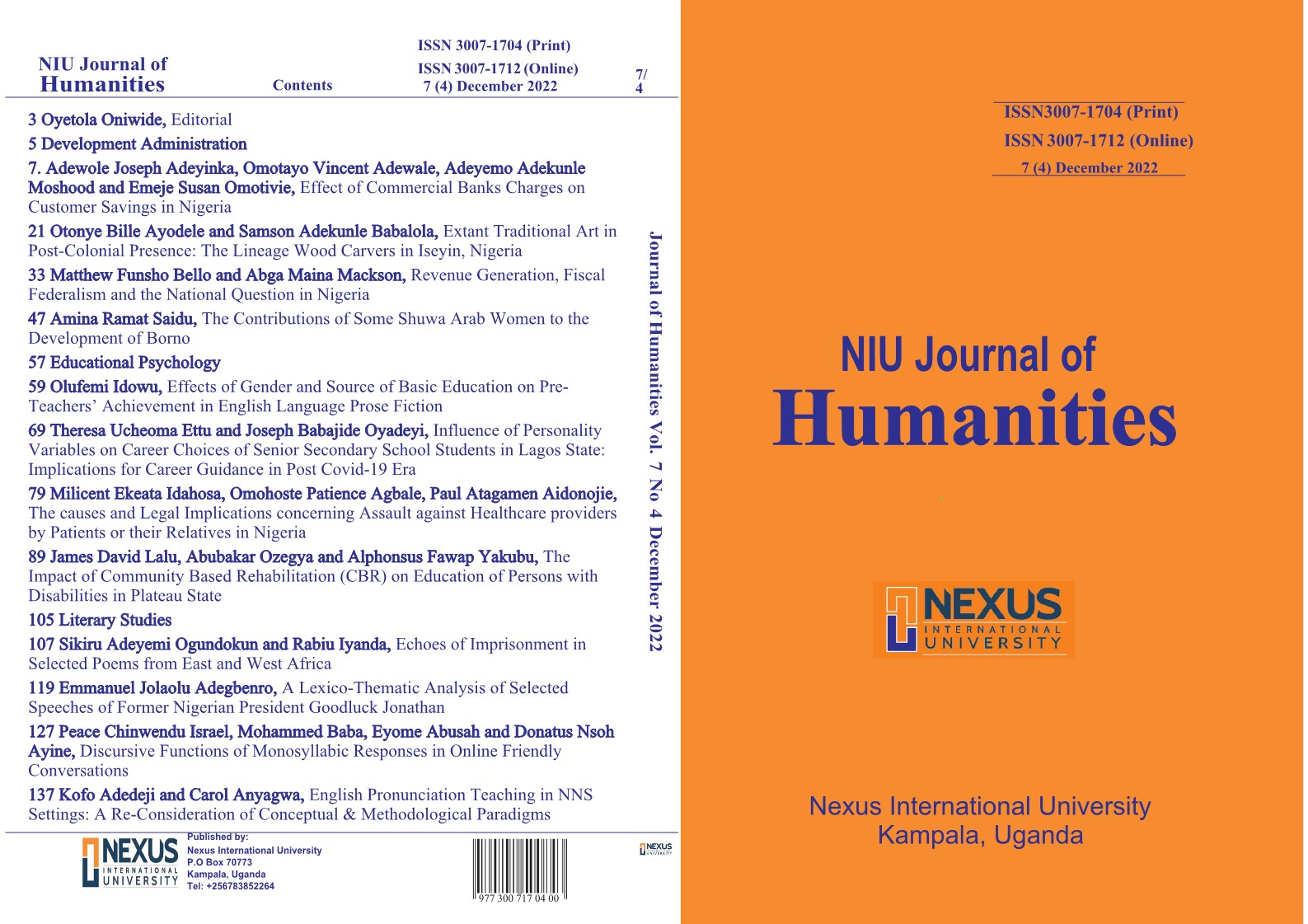 NIU Journal of Humanities, Vol. 7 No. 4, December 2022
Vol 7 No 4 (2022)
NIU Journal of Humanities, Vol. 7 No. 4, December 2022
Vol 7 No 4 (2022)This issue of NIU Journal of Humanities touches on Development Administration, Educational Philosophy as well as Literary Studies.
The first part of the Journal addresses issues in Development Administration such as Fiscal Federalism, Road Infrastructural Development, Economic Development, and Revenue Generation among others. One of the papers in this section reveals that Nigeria’s federalism seems not to have addressed the issues that have emanated from the agitators of the national question because there is over centralization of the fiscal policies. It is therefore, recommended that Nigeria’s fiscal system be reformed to meet up with challenges brought about by the imbalance in the provision of developmental projects to the different sectors of the economy which has led to the disharmonious agitations from the various regions of the country consequent from dissatisfaction with fiscal federalism.
Papers in section two explore issues in Educational Psychology. It is postulated in one of the papers that there is a significant influence of interest of students on their career choices. However, there is no significant influence of motivation of students on their career choices. Gender neither influence students’ motivation nor interest in the choices of their career. The paper recommends that students should endeavour to discover their real interest in order to choose careers that will suit them; they should be exposed to a number of trainings to sharpen their ICT skills to cope with the prevailing job performance challenges associated with our present age – the post covid-19 era.
The last section centres on Literary Studies. Literary devices in the works of some selected poets from East and West Africa are examined. Also, a lexico-thematic analysis of selected speeches of former Nigerian President Goodluck Jonathan is made. Based on the result of its findings, one of the papers in this section discovers that Goodluck Jonathan’s speeches reiterated five main thematic preoccupations which centered on ‘peace’, ‘faith’, ‘progress’, ‘patriotism’, and ‘transparency’, and these themes were skillfully wielded through a careful selection of synonymous lexical relations to project and emphasize the consistent messages in the sampled speeches.
In all, this issue of NIU Journal of Humanities features many empirical and theoretical based articles which can be of great benefit to every reader.
-
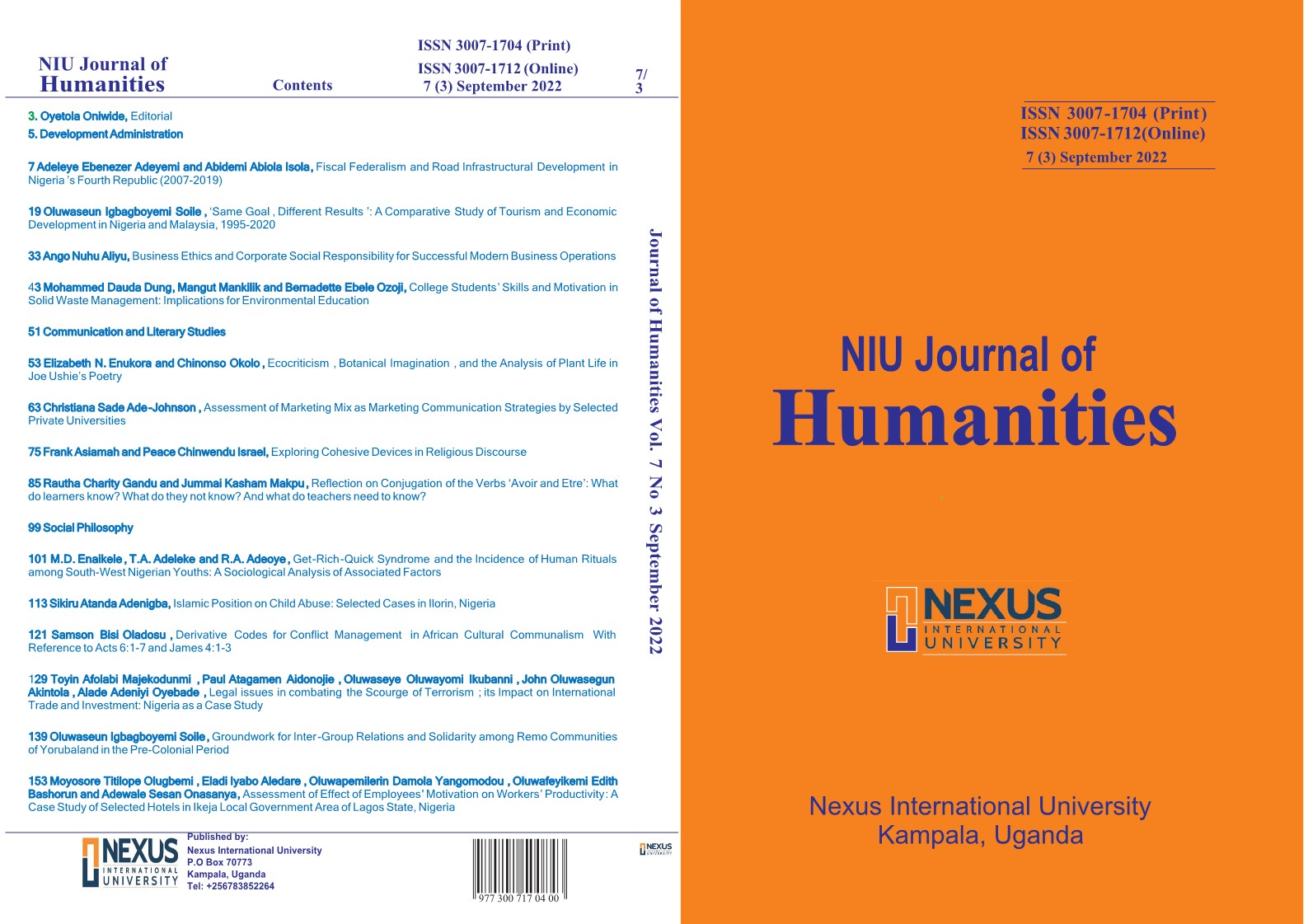 NIU Journal of Humanities, Vol. 7 No. 3, September 2022
Vol 7 No 3 (2022)
NIU Journal of Humanities, Vol. 7 No. 3, September 2022
Vol 7 No 3 (2022)This issue of NIU Journal of Humanities touches on Development Administration, Social Philosophy as well as Communication and Literary Studies.
The first part of the Journal addresses issues in Development Administration such as Fiscal Federalism, Road Infrastructural Development, Economic Development, Tourism, Social Corporate Responsibility and so on. One of the papers in this section reveals that fiscal federalism has not led to the improvement of road infrastructure in Nigeria and with improved fiscal federalism, Nigeria will experience infrastructural development. It is therefore, recommended that Nigeria should adapt fiscal federalism practice in the United States in which other federating units would not need to depend on the federal level for their infrastructure development. All Federating units should begin to develop innovative ways of improving internally generated revenue so as to improve provision of infrastructure within their domain.
Section two explores issues in Communication and Literary Studies such as Markrting Communication Strategies, Cohesive Devices in Religious Discourse, among others. Based on the result of the findings of its empiral Studies, one of the papers in this section recommends that private universities should mix their marketing tools strategically so they can effectively communicate the unique values they offer through their services.
Papers in the last section are on Social Philosophy. It is postulated in one of the papers that the present inordinate desperation of the youths to get-rich-quick is influenced by unemployment, online and Nollywood videos, peer influence, poor parenting and change in societal value system, economic deprivation and inequality in wealth distribution characterized by marginalization, limited opportunities and social exclusion of these youths perpetrating the criminal acts. The paper recommends that society should exhibit zero tolerance to the get-rich-quick syndrome of these youths. The federal and States governments should create job opportunities for the youths. The youths should also be encouraged to engage in entrepreneurial skills acquisition ventures that will provide them with means of earning income and wealth generation.
-
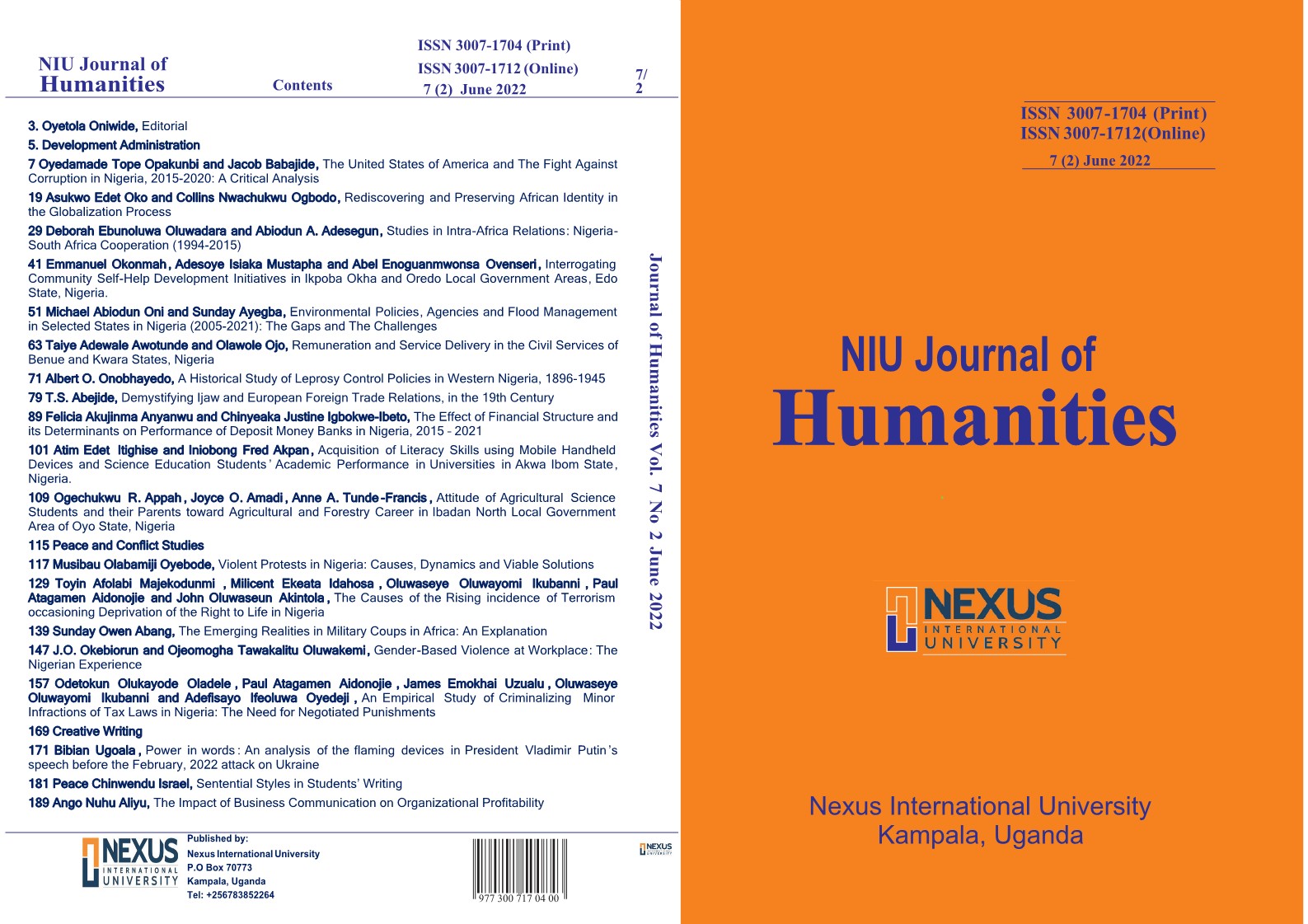 NIU Journal of Humanities, Vol. 7 No. 2, June 2022
Vol 7 No 2 (2022)
NIU Journal of Humanities, Vol. 7 No. 2, June 2022
Vol 7 No 2 (2022)This issue of NIU Journal of Humanities touches on Development Administration, Creative Writing as well as Peace and Conflict Studies.
The first part of the Journal addresses issues in Development Administration such as Anti Corruption Policies, Globalization, Envronmental Policies, Fiscal Federalism, International Economic Relations, Deregulation of Educational Services and so on. One of the papers in this section reveals that government environmental policies in the study area in the last fifteen years have not been adequately implemented. It is therefore, recommended that the Federal Government should review government environmental policies in the study areas. The study also recommended the setting up of a new dedicated and centralized agency for effective flood risk management in Nigeria.
Section two explores issues in Peace and Conflict Studies such as Terrorism, Violent Protests, Military Coup Detat, Gender-Based Violence at Work Place and Minor Infractions of Tax Laws. Based on the result of the findings of its empiral Studies, one of the papers in this section recommends that both government and employers of labour should eliminate all forms of violence against women through reactivation of gender and equal opportunities bills and labour laws in Nigeria.
Papers in the last section are on Creative Writings. It is postulated in one of the papers that flaming devices have the tendency to infuriate the target(s) of the speech, and elicit negative reactions. The paper recommends that since the world has become a global village, discourses of prominent persons should be devoid of devices that have the propensity to infuriate the hearers and stimulate negative feelings and reactions. Another paper in this section also argues that there is monotony in their writing style and monotonous writing is ineffective writing style. The paper concludes by recommending possible solutions to effective and elegant writing for effective communication and enhanced performance in English.
On the whole, this issue of NIU Journal of Humanities features many empirical and theoretical based articles which can be of great benefit to every reader.
-
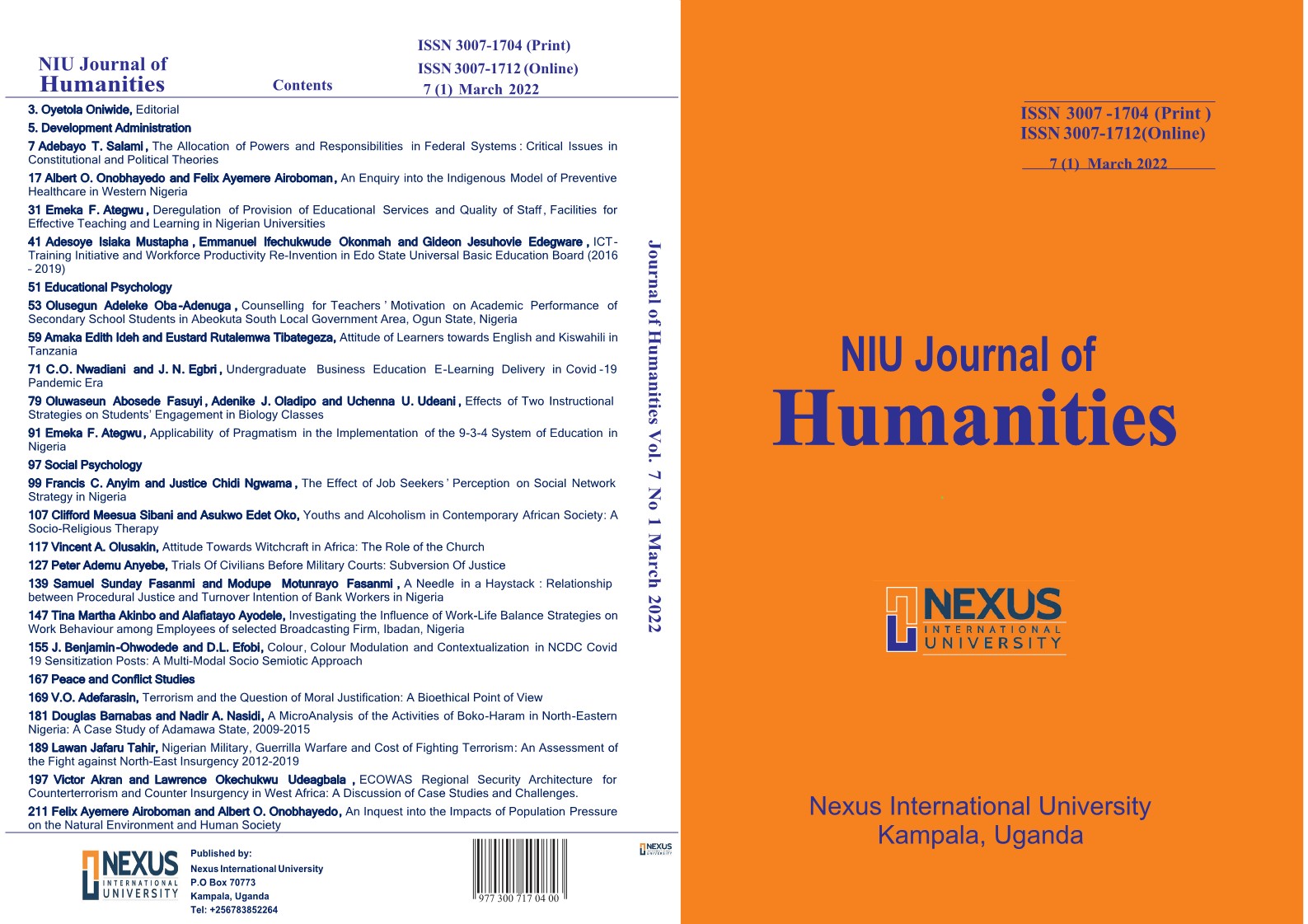 NIU Journal of Humanities, Vol. 7 No. 1, March 2022
Vol 7 No 1 (2022)
NIU Journal of Humanities, Vol. 7 No. 1, March 2022
Vol 7 No 1 (2022)This issue of NIU Journal of Humanities touches on Development Administration, Educational Psychology, Social Psychology as well as Peace and Conflict Studies.
The first part of the Journal addresses issues in Development Administration such as Fiscal Federalism, Preventive Health Care System, Deregulation of Educational Services and so on. One of the papers in this section argues that the issues and fundamentals of federalism in both constitutional and political theories should be approached from the developmental perspective and through this, it is hoped, federalism will restore its vitality where it has been battered and its direction where the focus appears uncertain, unclear and muddled-up.
Section two explores issues in Educational Psychology such as Teachers' Motivation, Learners' Attitudes and Pragmatism. Examining the counselling for teachers' motivation on academic performance of secondary school students in Abeokuta South Local Government Area of Ogun State, Nigeria, one of the papers in this section reveals a significant relationship between teachers' motivation and students' academic performance. It also shows a significant relationship between strategies used to motivate teachers and students' academic performance. Finally, the paper reveals a significant relationship between condition of service of teachers and academic performance and finally recommends that Government should ensure regular payment of teachers' salaries and prompt promotion as at when due.
In the Section on Social Psychology, one of the papers argues that the perception of job seekers will significantly affect the use of social network strategy amongst other advantages or outcomes. The study therefore, recommends the creating of awareness on the usefulness of social network in job search in a bid to reduce the negative perception of the populace on its effectiveness as a viable option for job search in Nigeria.
Papers in the last section are on Peace and Conflict Studies. It is postulated in one of the papers that concludes that there is no moral justification for terrorism, it is unethical because it is evil, it is a serious, heinous and nefarious crime, hence, we should all rise up for its utter condemnation. Another paper in this section also examines some war techniques that were demonstrated by the Boko Haram militants have beensubstantiated which were entirely new to the knowledge of the Nigerian military. The research paper at the end discusses way out to handle such problems in future by suggesting the total review of the military institution in terms of training, operation, discipline, professionalism, improvement in intelligence gathering and possession of modern warfare technology.
On the whole, this issue of NIU Journal of Humanities features many empirical and theoretical based articles which can be of great benefit to every reader.
-
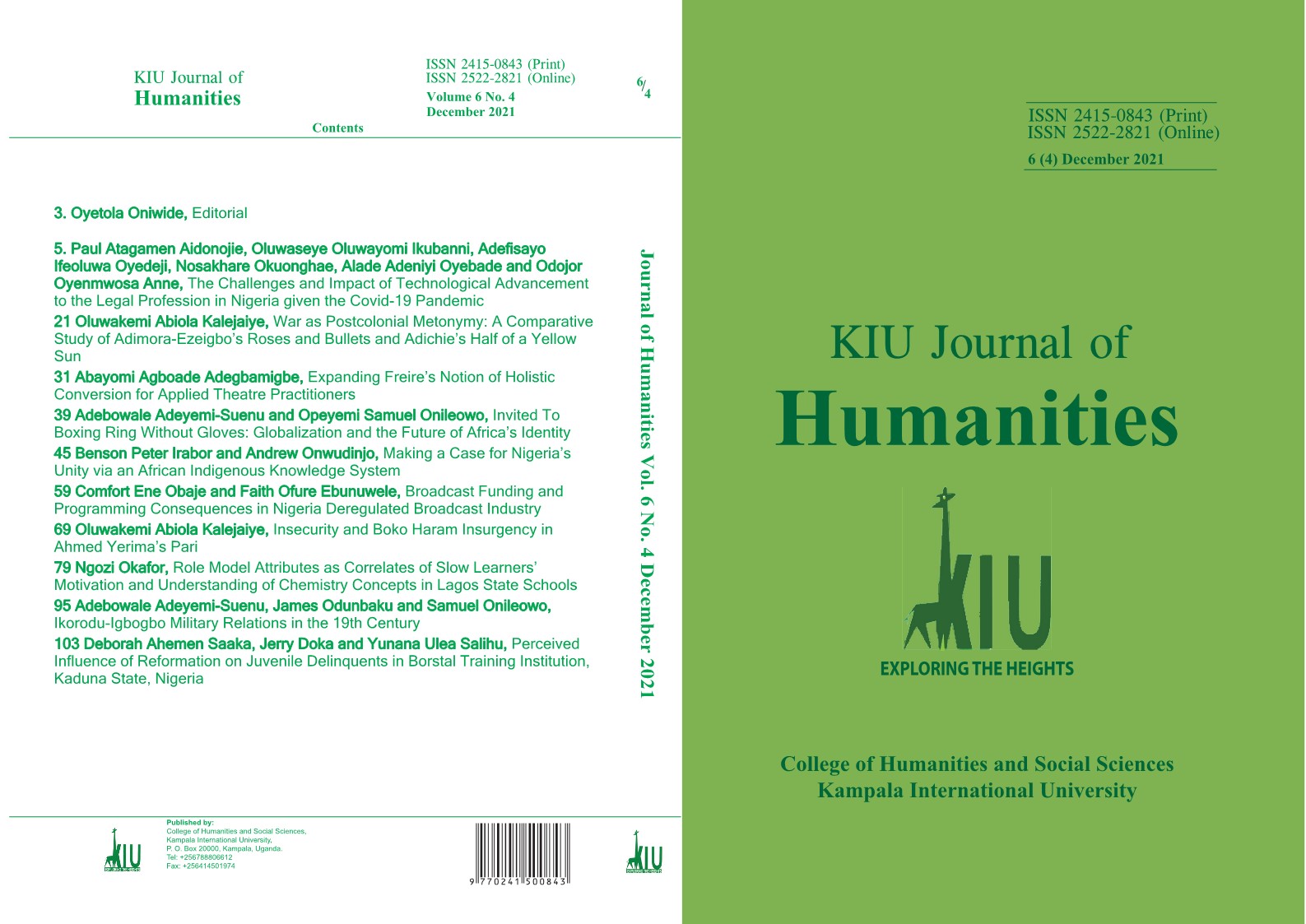 KIU Journal of Humanities, Vol. 6 No. 4, December 2021
Vol 6 No 4 (2021)
KIU Journal of Humanities, Vol. 6 No. 4, December 2021
Vol 6 No 4 (2021)This issue of KIU Journal of Humanities touches on Development Administration and Literary Studies.
The first paper in this edition employs a doctrinal and empirical non-doctrinal method in investigating how technological facilities have impacted the smooth operation of the legal profession in Nigeria during the Covid-19. An online questionnaire survey was sent to 313 respondents (randomly selected) who live in Nigeria. Descriptive and analytical methods were used in analysing the data obtained. The study found that the occurrence of the covid-19 in Nigeria has led to the use of technological facilities, which has further impacted significantly in the operation of the legal profession. However, there are several challenges in using technological facilities. The study therefore recommends and concludes that there is a need to legally intensify and embrace the use of technological facilities in the operation of the legal profession.
Another paper this issue also explores an indigenous approach that can be applied in the educational sector for full effect without incurring the wrath of politics of suspicion. Through the method of philosophic analysis, this research foregrounds that the philosophy of Harambeeism has the capacity to inform a positive leaning for national unity in Nigeria.
On the whole, this issue of KIU Journal of Humanities features many empirical and theoretical based articles which can be of great benefit to every reader.
-
KIU Journal of Humanities, Vol. 6 No. 3, September 2021Vol 6 No 3 (2021)
This issue of KIU Journal of Humanities touches on Development Administration and Social Psychology.
The first part of the Journal addresses issues in Development Administration such as Local Government Administration, Religious Politics, Police Reforms and Costitutional Design. Using Nigerian Police Service Reform as a Case Study, one of the papers in this section argues, among other things, that the poor performance of Nigeria Police is more of an orientational, than structural, problem. It, therefore, concludes that the right change in the orientation and approach of the police, the government, and other stakeholders to police reforms will make the police function expectedly. So, it is recommended that the process of change of orientation, approach, and, maybe, structure of the police should be designed to be a collective effort of all the stakeholders.
The second section which centers on Social Psychology, examines various psychology factors which have impacts on the society, and these include sexual education, psychopathy among criminals and non criminals, use of social media and organizational reward system. One of these papers reveals that among others that teachers and parents have a good attitude about sexuality education as a subject in Nigerian secondary schools. Based on the findings, the paper recommends that sexuality education should be introduced in schools early enough. Since both parents and teachers are understandably disposed to sexuality education, public enlightenment should be carried out to improve on public attitude towards sexuality education.
In all, this issue of KIU Journal of Humanities features many empirical and theoretical based articles which can be of great benefit to every reader.
-
KIU Journal of Humanities, Vol. 6 No. 2, June 2021Vol 6 No 2 (2021)
This issue of KIU Journal of Humanities touches on Development Administration, Social Psychology, Educational Psychology and Communication Studies.
The first part of the Journal addresses issues in Development Administration such as waste management, accountability and transparency, rural development, poverty alleviation, sustainable development goals, anti corruption efforts, rail revolution, nation building, and globalization. One of the papers in this section argues that education has a role in improving the lives of women with attendant benefit to empower and promote gender parity in society. It is therefore suggested that since gender parity is important and the role of women central to socio-economic development, government should enact a policy to ensure quality education become a major block of empowering women at every local government area in Nigeria.
The second section which centers on Social Psychology, examines various psychology factors which have impacts on the society, and these include sexual morality among adolescents, parenting styles, career management, youth empowerment, job insecurity; trans-border crimes, mental disorder and corporal punishment. One of these papers reveals that human trafficking has a negative effect on socio economic growth in Nigeria. The paper recommends that government should look into factors necessitating trans-border crimes and take legal actions against offenders.
The third section which centers on Educational Psychology highlights various social innovations which have impacts on teaching and learning activities in the society. One of these papers reveals that the motivation of students that were exposed to m-learning differs from the motivation of students that were not exposed to m-learning. It therefore suggests that m-learning should be integrated into the teaching and learning activities of tertiary institutions in Nigeria. In addition, students and lecturers at the higher level of education should be encouraged to possess m-learning devices and utilize m-learning for teaching and learning exercise. It was likewise recommended that lecturers should collaborate with computer programme designers to design m-learning based virtual classrooms.
In the last section, communications skills in both religious and literary world are examined. It is revealed in one of the papers that Writers of Christian religious tracts in the Nigeria rely on emotional appeals, logical proofs and ethics as means of maintaining interpersonal relation with their readers. Also, they assume the position of divine authority and/or of better informed persons to counsel their readers. This conclusion was drawn after the researcher had critically examined the linguistic strategies and the discourse functions of appeal in eleven Christian religious tracts purposively selected from forty tracts collected from about fifteen churches and ministries in Ondo State, South-western Nigeria.
In all, this issue of KIU Journal of Humanities features many empirical and theoretical based articles which can be of great benefit to every reader.
-
KIU Journal of Humanities, Vol. 6 No. 1, March 2021Vol 6 No 1 (2021)
This edition of KIU Journal of Humanities touches on Development Administration, Social Philosophy, Social Psychology as well as Teaching and Learning.
The first part of the Journal addresses issues in Development Administration such as rural development, poverty alleviation, sustainable development goals, public service delivery, , nation building, domestic and foreign direct investment and so on. One of the papers in this section argues that education is a veritable avenue to remove ignorance, increase level of income etc. It is therefore suggested that Transformation Approach and Improvement Approach may be adopted to bring rural and urban areas at par: Transformation Approach puts emphasis on the development of socio-economic factors available in order to experience a sustained growth and marked increase in the level of inputs that is complementary to labour and work done in the rural areas to increase income and financial independence. All these put together form the structure upon which the healthcare delivery is anchored in any society and the determinants of its infrastructure and the extent of patronage. Therefore, according to the paper, for quality rural health, all these are to be in place with adequate budget allocation.
In the second section which centers on Social Philosophy, various issues in the society and their underlining philosophies were examined. Some of the social issues include social relevance, moral decadence, ethical consideration, culture and religion. One of these papers reveals that Philosophy has played and will continue to play vital roles in the development of our society. In order to achieve its intended objective therefore, the paper discusses meaning and definition of Philosophy, branches of Philosophy, “the ten commandments†of Philosophy. The paper concludes that Philosophy contributes meaningfully to the growth of any society.
The third section which centers on Social Psychology examines various psychology factors which have impacts on the society, and these include trauma, teenage sexting, suicide ethos, satisfaction etc. One of these papers reveals that nightmares, mental breakdown, helplessness, lack of trust, and self-effacement can be read as symptoms of repressed childhood traumatic experiences. It concurs with Cvetkovich and Blooms’ assertion that trauma can be an external built-up of unpleasant events that affect the victim's psychological state which in turn affects the individual’s external actions in life.
In the last section, the importance of teaching and learning skills on students’ achievements are examined. It is revealed in one of the papers that teachers’ acquired skills and attitude competencies from Business Education programme were lower than secondary school required skills and attitude competencies. This is because, according to the paper, the contents of Business Education programme do not provide students with adequate skill and attitude competencies for them to perform at the level expected of them after graduation. The paper, therefore, recommends that the curriculum of Business Education programme should be reviewed and restructured so as to enable the graduates respond to social goals, economic realities and future life challenges.
-
KIU Journal of Humanities, Vol. 5 No. 4, December 2020Vol 5 No 4 (2020)
This edition of KIU Journal of Humanities touches on Development Administration, Social Psychology and Literary Studies.
The first part of the Journal addresses issues in Development Aministration such as social security and national development, public service delivery, global pandemic and development, administrative law, foreign direct investment and so on. One of the papers in this section argues that social security scheme in Nigeria is falling short as a response to the needs of the poor and suggests, among others, the need to develop an overarching social security scheme to provide clear institutional roles and responsibilities, lay out series of options for social security in the country. This, according to the paper, is based on the fact that strong institutions are needed as back bone for whatever policy the government is considering to implement.
In the second section which centers on Social Psychology, various social factors which have impacts on the society, which may include drug abuse, feeding habit, ethical consideration etc. are examined. One of these papers reveals that there is a great relationship between Substance Abuse and Suicidal Ideation among Youths in Kaduna North, Nigeria. Based on the findings of this study, it is recommended among others; that there should be measures in place to curb this menace due to its adverse effects on our youths and by implication the nation at large. Another paper also examines the concept of epistemic claim to knowledge and the tripartite criteria arising from Plato’s attempt to justify the claim to knowledge in epistemology. The researcher is of the opinion that there are no absolute criteria that are holistic enough to address the question of epistemic justification and this is why there have been several epistemological criteria in the contemporary epistemology as additional formulations to strengthen the criteria of evaluation of statement claims, beliefs and truth in epistemology. The paper concludes that it is for this reason that such epistemic theories like contextualism, pragmatism, foundationalism, coherentism et.al have emerged as an additional force for strengthening the question and the problem of epistemic justification.
In the last section, literary works of Tunde Kelani, Ifeoma Okoye and others are x-rayed. Also, one paper in this section examines two Niger Delta plays namely: Peter Omoko’s Crude Nightmen (2015) and Stephen Kekeghe’s Pond of Leeches (2015). It is revealed that the playwrights are unequivocal in holding indigenous leaders and citizens complicit for the systemic impoverishment of the region as a result of placing personal interests over communal progress. However, they also balance their narratives by creating parallel sets of local characters who deploy intellectual and radical forms of agency towards the liberation of their oppressed people and despoiled environment from the machinations of the enemy within.
In all, this issue of KIU Journal of Humanities features many empirical and theoretical based articles. Each of them seeks to profer solutions to one social and management problem or the other. Therefore, there is something to learn by every reader of this issue.
-
KIU Journal of Humanities, Vol. 5 No. 3, September 2020Vol 5 No 3 (2020)
This edition of KIU Journal of Humanities touches on Development Administration, Social Psychology, Religious Studies, Communication Arts and Literary Studies, as well as Educational Management and Educational Technology.
The first part of the Journal addresses issues in Development Aministration such as internal security and national development, public service delivery, global pandemic and development, crisis of nation building, globalization, foreign direct investment and so on. It is revealed in one of the papers that bureaucracy in Africa should help manage the resources of the state in a manner that much money is conserved for developmental purposes. Ironically, the civil bureaucracies have become huge drain on the scarce resources of the State through a number of avenues; some are official while others illicit. Thus, bureaucracies can be modified to accommodate the influx of change in ideas, culture and values, and adapt to new situations or changing circumstances. It therefore suggests that it is important to reform it to conform to the realities of the 21st century, and until the African bureaucracy is transformed to be people-oriented, transparent and accountable to the people; cost of governance in Africa will remain an obstacle to Africa’s development.
In the second section which centers on Social Psychology, various social factors which have impacts upon students, which may include parental attitude, nutritional practices, teachers’ attitudes, emotional intellegence, study habit, peer groups, emotional sentiments, and mental hygiene etc. are examined. One of these papers reveals that there is no significant difference between parental attitudes towards the teaching of sex education, majority of the respondents supported the teaching sex education in secondary schools, parents attitude changes based on their marital status, parent in urban and rural areas do not have similar attitude towards the teaching of sex education. Based on the findings of this study, it is recommended among others; that teaching of sex education should be encouraged in all secondary schools. In addition, parents in urban and rural areas should be educated to develop positive attitude towards the teaching as well as educating the children at home on the subject matter.
In Section Three, literary works of Chukwuemeka Ike, Festus Iyayi and Ojaide Agbogidi are x-rayed. Also, one paper in this section investigates how Boko Haram identity is constructed in Abubakar Shekau’s speeches from a socio-pragmatic approach in a bid to revealing the sect’s identity orientations and ideology. It is revealed that the sect’s identity orientations when perceived from the way they see themselves provide a socio-pragmatic approach to ‘war on terror’ in curbing terrorist activities in Nigeria.
In part four, some importance issues in Religious Studies are examined. One of the papers explains the phenomena of the involvement of ‘men of God’ in all sorts of crime make headlines in local and international newspapers and magazines. It concludes that if all criminal offences are punished as at when due, and irrespective of status, a growing culture of crime generally in the country and particularly among the clerics would stop.
Sections Five and Six examine salient issues in Educational Management and Educational Technology. Some of these include first aid services in schools, Curriculum development, Quality Assurance and influence of ICT maturity on teaching and learning. Relying on findings from a descriptive survey, it is disclosed in one of the papers that ICT maturity is poor and cannot drive correctional education service delivery efficiently in Nigerian correctional facilities as most inmates do not have access to it. It is, therefore, recommended that ICT infrastructure should be provided to re-position education service delivery in Nigerian correctional system by the Federal government of Nigeria.
In all, this issue of KIU Journal of Humanities features many empirical and theoretical based articles. Each of them seeks to profer solutions to one social and management problem or the other. Therefore, there is something to learn by every reader of this issue.
-
KIU Journal of Humanities, Vol. 5 No. 2, June 2020Vol 5 No 2 (2020)
This issue of KIU Journal of Humanities touches on Development Studies, Social Psychology, Religious Studies, Language and Literary Studies, as well as Entrepreneurship and Agricultural Economics.
The first part of the Journal addresses issues in Development Studies such as internal security and national development, public service delivery, global pandemic and development, crisi of nation building, globalization, imperialism and so on. It is revealed in one of the papers that the emergency of the virus in some towns and cities in Nigeria calls for serious attention. The paper therefore, recommends among others, the isolation or restriction of movement of suspected cases within the facility, banning of visits to detention facilities, decongestion of correctional facilities and setting up of disease prevention and control units in correctional or detention facilities across the country in order to stem the spread of the virus to correctional facilities.
In the second section which centers on Social and Educational Psychology, various factors which have impacts upon students, which may include emotional intellegence, study habit, peer groups, emotional sentiments, and mental hygiene etc. are examined. One of these papers reveals that that Narrative Exposure Therapy (NET) had no effects difference on participants’ psychological trauma symptoms across age group. Based on the findings of this study, it is recommended among others; that there is need for more psychological studies to be conducted amongst children at internally displaced camps so that both young and old would have gone through the therapy. In addition, future studies should be done for children in the Internally Displaced Persons’ camps for the purpose of comparing between children, adolescents and old that have gone through the therapy.
In Section Three, literary works of Ola Rotimi, Sam Ukala, Usimi Taiwo, as well as Mongo Béti and Ahmadou Kourouma are x-rayed. Also, language and tenor of President Muhammadu Buhari’s Speech on covid-19 pandemic to the general populace in Nigeria are examined in one of the papers. It is revealed that the President used declarative sentences as a way of giving information to the audience and also for creating a natural conversational phenomenon between the president and the listeners so that the general populace could understand the intended message(s). The study concludes that examining nationwide broadcast given during this pandemic through the language use, metadiscourse elements, and tenor of discourse aid comprehension of the intended message being passed across to the audience.
In part four, some importance issues in Religious Studies are examined. One of the papers highlights the Islamic perspectives of what is called child spacing or control. The paper rejects the idea of child spacing or birth control based on western model and argues in favour of child spacing from the Islamic point of view based on ‘azl’ and the Islamic model of child rearing and weaning as supported by relevant Qur’anic verses.
Section Five examines salient issues in Entrepreneurship and Agricultural Economics. Some of these include agricultural credit loans, teaching business education and food technology. It is disclosed in one of the papers there is a positive but insignificant relationship between intangible assets and profitability of Nigeria’s deposit money banks. Therefore, organisations should invest significantly in intangible assets in order to boost profitability.
In all, this edition of KIU Journal of Humanities features many empirical and theoretical based articles. Each of them seeks to profer solutions to one social and management problem or the other. Therefore, there is something to learn by every reader of this issue.

Language
Information

